

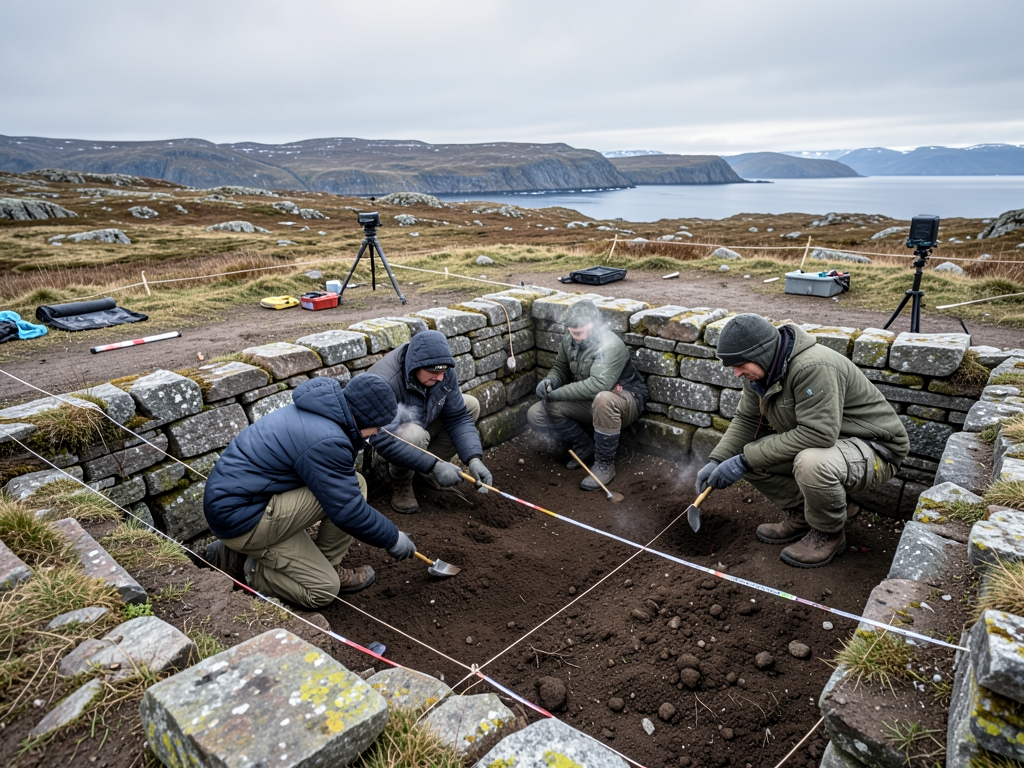
Archaeological exploration in the remote, unforgiving landscapes of the North Atlantic has long captured the imagination of historians and the general public alike. For centuries, the fate of the medieval Norse settlements in Greenland has remained one of history's most compelling puzzles. Why did a thriving community of European settlers, who established churches, farms, and complex social structures, seemingly vanish into the mists of history by the late Middle Ages? Recent archaeological breakthroughs are shedding fresh light on these enduring mysteries, offering tangible clues about how these hardy communities lived, worshipped, and adapted to an increasingly harsh environment.
At the center of these recent discoveries is the unearthing of a Scandinavian church site in Greenland—the first such major structural discovery in over six decades. This monumental find not only enriches our understanding of medieval architecture in the far north but also provides critical insights into medieval Christian burial practices and the spiritual life of Norse colonists. As modern researchers employ advanced excavation techniques, non-invasive imaging, and meticulous archival analysis, the forgotten chapters of Greenland’s medieval past are steadily being brought back into the light.
The Historical Context of Norse Greenland
To fully appreciate the significance of recent archaeological finds, one must look back to the late tenth century when Erik the Red established the first Norse settlements in Greenland. Driven from Iceland by family feuds, Erik and his followers sailed west, encountering a massive, ice-dominated island that, through clever marketing or hopeful optimism, they named Greenland. Despite the severe climate, the settlers established three primary regions along the sheltered fjords of the southwestern coast: the Eastern Settlement, the Western Settlement, and the lesser-known Middle Settlement.
At its peak, the medieval Greenlandic population numbered several thousand individuals. They built sprawling homesteads, raised livestock, traded walrus ivory with European merchants, and practiced a deeply ingrained form of Christianity. Historical records indicate that the Greenlandic diocese was established in the twelfth century, complete with a cathedral at Garðar. Churches were the beating heart of these isolated communities, serving not only as spiritual sanctuaries but also as community gathering places, administrative centers, and markers of cultural identity in a vast, alien landscape.
However, as the centuries progressed, environmental and economic pressures mounted. The onset of the Little Ice Age brought cooler temperatures, shorter growing seasons, and thickening sea ice that made maritime travel to and from Europe increasingly treacherous. By the fifteenth century, written records of the settlements ceased entirely, leaving behind stone ruins, abandoned churchyards, and a historical silence that researchers have spent centuries trying to break.
Unearthing the Lost Scandinavian Church
The recent unearthing of a medieval Scandinavian church in Greenland marks a watershed moment for Arctic archaeology. Finding a previously unknown ecclesiastical structure after more than sixty years without such a discovery is an extraordinary feat. Unlike urban European archaeological sites that are buried under layers of subsequent modern development, Greenlandic ruins often lie exposed to the elements, slowly reclaimed by tundra moss, shifting soils, and coastal erosion.
The newly investigated site preserves remarkable architectural features that reveal how medieval builders adapted European ecclesiastical traditions to local materials. With limited access to timber, builders relied heavily on locally quarried stone, turf, and clay mortar to construct sturdy, thick-walled chapels capable of withstanding fierce Arctic winds and heavy snow loads. Excavations at the site have revealed foundational layouts, altar placements, and architectural fragments that mirror contemporary parish churches found in medieval Norway and Iceland, while reflecting the unique practical constraints of frontier life.
Furthermore, the surrounding churchyard has yielded invaluable data concerning medieval Christian burial practices in the Arctic. Analyzing burial orientation, skeletal preservation, and grave construction offers a window into the demographic makeup, health, and social hierarchy of these isolated congregations. Archaeologists have noted specific burial alignments oriented toward the east, consistent with traditional Christian theology, alongside unique local variations in grave marker placement and stone-lined cists designed to protect remains in shallow, frozen soils.
Illuminating Medieval Christian Burial Practices
Burial sites are among the most informative archives available to historical researchers. In medieval Christian societies, the manner in which an individual was interred reflected religious devotion, social standing, and prevailing cultural norms. In Greenland, the extreme environment posed unique challenges for burial parties, who had to dig through frozen ground—often referred to today as permafrost or seasonally frozen earth—using primitive iron tools.
Recent investigations into Greenlandic churchyards have highlighted how Norse settlers maintained their religious traditions despite being separated from mainstream European ecclesiastical authority by thousands of miles of ocean. The arrangement of graves, the absence or presence of grave goods, and the positioning of skeletal remains all point to a deeply pious community striving to adhere strictly to canon law regarding burial consecration and churchyard sanctity.
Bioarchaeological analysis of the human remains recovered from these sites provides profound details about the physical lives of medieval Greenlanders. Researchers examine dental wear patterns, bone density, and pathological markers to reconstruct diet, workload, and disease prevalence. Interestingly, despite the harsh climate, isotope analysis of tooth enamel suggests that early generations maintained a mixed diet combining Norse pastoralism—such as sheep and cattle farming—with significant marine resource consumption, particularly seals and fish.
Info! Modern archaeological techniques, including ground-penetrating radar and photogrammetry, allow researchers to map delicate structural features and subsurface graves without disturbing sensitive historical deposits.
Technological Advances in Arctic Archaeology
The success of recent excavations in Greenland underscores the transformative impact of modern technology on historical research. Decades ago, locating a buried stone ruin required extensive manual trenching, sheer luck, and grueling physical labor across remote terrain. Today, archaeologists deploy a sophisticated array of non-invasive remote sensing tools before ever turning a shovelful of earth.
Magnetometers and electrical resistivity tomography (ERT) allow scientists to peer beneath the turf, detecting stone foundations, buried hearths, and subsurface anomalies based on subtle variations in magnetic fields and soil moisture. Drone-mounted multispectral and thermal cameras capture high-resolution aerial imagery that can reveal crop marks and subtle topographical depressions invisible to the human eye at ground level.
Once excavations begin, conservation scientists work alongside field archaeologists to stabilize fragile organic artifacts—such as textiles, wooden implements, and leather fragments—that are exceptionally well-preserved in the cold, damp soils of the North Atlantic. These interdisciplinary collaborations ensure that fragile historical data is captured with maximum precision, safeguarding our shared cultural heritage for future generations.
The Broader Significance of Norse Heritage Preservation
The preservation and study of medieval sites in Greenland hold significance far beyond academic curiosity. These fragile remnants of human resilience serve as a powerful testament to how past societies coped with environmental instability, resource scarcity, and profound geopolitical isolation. As modern communities face their own contemporary climate challenges, the historical record left by the Norse settlement offers sobering lessons in ecological adaptation and the limits of human resilience in fragile environments.
Moreover, these archaeological discoveries foster international cooperation between Greenlandic authorities, Scandinavian research institutions, and global academic networks. Protecting these coastal sites from the growing threat of climate change—particularly coastal erosion driven by rising sea levels and thawing permafrost—has become an urgent priority for heritage preservationists worldwide.
| Settlement Region | Primary Characteristics | Key Archaeological Findings |
|---|---|---|
| Eastern Settlement | Largest concentration of farms and churches | Cathedral ruins, episcopal manors, rich farming estates |
| Western Settlement | Northernmost farming zone, closer to Inuit hunting grounds | Churches, communal halls, extensive caribou bone assemblages |
| Middle Settlement | Smaller, more isolated cluster of agricultural outposts | Scattered homesteads, small chapels, localized burial sites |
Conclusion
The unearthing of the new Scandinavian church in Greenland reminds us that history is not a closed book; rather, it is a dynamic narrative continually rewritten by new discoveries and scientific ingenuity. By carefully piecing together the physical evidence left behind by medieval settlers, modern archaeologists are giving voice to a remarkable society that dared to build a European-style Christian community at the edge of the habitable world. As research continues across the North Atlantic, these frozen archives will undoubtedly yield even more secrets, enriching our understanding of human history and cultural persistence.
When was the newly discovered Scandinavian church in Greenland unearthed?
The discovery was announced in November 2026, marking the first major Scandinavian church site unearthed in Greenland in over six decades.
What architectural materials did medieval Norse settlers use in Greenland?
Due to a scarcity of local timber, builders relied heavily on quarried local stone, turf, and clay mortar to construct durable walls capable of withstanding Arctic weather.
What do medieval Christian burial practices reveal about the Norse settlers?
Burial alignments and grave construction demonstrate that these isolated frontier communities maintained strict adherence to traditional Christian theology and ecclesiastical customs.
Why did the medieval Norse settlements in Greenland eventually disappear?
The decline was driven by a combination of worsening climatic conditions during the Little Ice Age, changing economic networks, and increasing environmental and resource pressures.
