

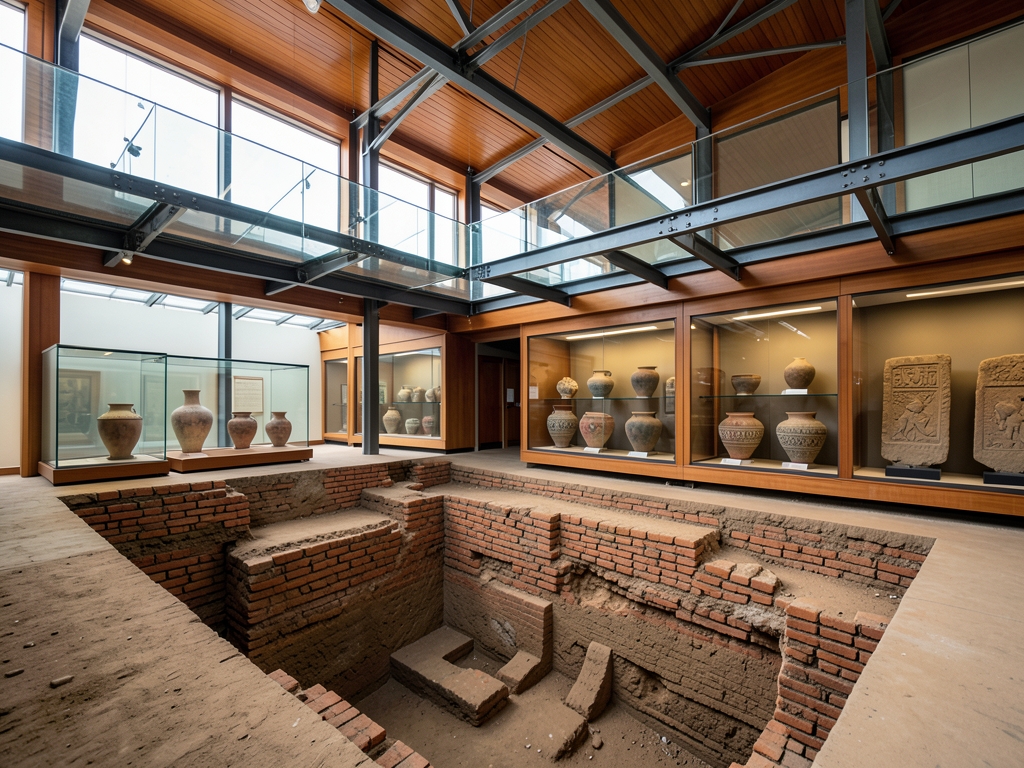
In an unprecedented triumph for South Asian cultural heritage and museum architecture, the Vadnagar Archaeological Museum in Gujarat, India, has been honored with the prestigious Red Dot 'Best of the Best' Award 2026 at a ceremony held in Berlin, Germany. The international award recognizes exceptional spatial design, narrative curation, and structural innovation, celebrating the facility's ability to fuse cutting-edge museum architecture with active subterranean archaeological dig sites. Marking a major historic milestone, Vadnagar has become the first Indian museum project to secure the top tier of recognition at the global Red Dot Design Awards, bringing international spotlight to one of the world's most enduring historical settlements.
Located in the Mehsana district of northern Gujarat, Vadnagar is an ancient city whose continuous human habitation spans more than 2,500 years. Unlike many ancient settlements that were abandoned due to climate shifts, warfare, or natural disasters, Vadnagar has maintained unbroken urban activity from the 6th century BCE through the modern era. The award-winning museum project was designed to honor this unique living legacy by constructing a state-of-the-art facility directly over open archaeological trenches, allowing visitors to experience the stratified history of ancient India in real time.
The Red Dot Recognition: Global Design Distinction in Berlin
The Red Dot Design Award, headquartered in Essen and host to annual international galas in Berlin, represents one of the world's most respected seals of approval for architectural, product, and spatial design. The 'Best of the Best' distinction is reserved exclusively for groundbreaking concepts that demonstrate creative vision, functional clarity, and cultural resonance.
The international jury praised the Vadnagar Archaeological Museum for abandoning traditional, static exhibit formats in favor of an immersive spatial narrative. Rather than removing artifacts from their context and placing them behind distant glass cases in generic exhibition halls, the museum integrates the physical soil strata and original architectural foundations of ancient Vadnagar directly into the visitor journey. Structural glass pathways, elevated walkways, and precise lighting schemes enable museum-goers to peer directly down into active archaeological dig pits where artifacts were originally uncovered.
Info! The Red Dot 'Best of the Best' Award is granted to less than one percent of global submissions each year, highlighting Vadnagar Museum's position as a benchmark in modern heritage architecture.
Unbroken Chronology: Seven Cultural Strata of Ancient Vadnagar
Archaeological investigations conducted over several decades by the Archaeological Survey of India (ASI) alongside the Gujarat State Department of Archaeology have revealed seven distinct cultural layers preserved beneath Vadnagar. These stratified deposits provide invaluable empirical evidence of political, economic, and religious transformations across South Asia over two and a half millennia.
Historical records and epigraphic evidence refer to Vadnagar by several ancient names throughout different epochs, including Anartapura, Anandapura, and Chamatkarpura. Excavations have established that the settlement possessed sophisticated urban infrastructure, water harvesting systems, defensive fortification walls, and thriving trade networks that connected inland western India with Mediterranean, Central Asian, and Southeast Asian commerce routes.
| Cultural Period | Approximate Era | Key Architectural & Artifactual Discoveries |
|---|---|---|
| Pre-Mauryan & Mauryan | 6th Century BCE – 2nd Century BCE | Mud-brick structures, Northern Black Polished Ware (NBPW), punch-marked silver coinage. |
| Indo-Greek & Kshatrapa | 2nd Century BCE – 4th Century CE | Votive tablets, Roman amphorae fragments, terracotta figurines, defensive stone walls. |
| Gupta & Post-Gupta | 4th Century CE – 8th Century CE | Buddhist monastic complex, stupa foundations, carved stone sculptures, clay seals. |
| Solanki (Chalukya) | 10th Century CE – 13th Century CE | Ornamental stone gateways (Toranas), stepwells (Vavs), intricate temple carvings. |
| Sultanate & Mughal | 14th Century CE – 18th Century CE | Glazed ceramics, Islamic coinage, residential brick complexes, defensive bastions. |
| Maratha & British Period | 18th Century CE – 20th Century CE | Administrative documentation, civic infrastructure, commercial register archives. |
"Vadnagar represents an extraordinarily rare historical model: an urban center where seven distinct historical periods rest stacked beneath a living town, preserving 2,500 years of human memory in a continuous vertical sequence."
Architectural Engineering: In-Situ Exhibition Design
Designing a museum over an active archaeological site presented immense engineering challenges. The structural architecture had to provide spacious public galleries while ensuring zero physical load or vibration damage to the fragile ancient brickwork and unexcavated soil layers beneath. Engineers and architectural planners devised a suspended structural framework supported by deep foundation piers placed carefully outside sensitive archaeological zones.
Inside the museum, non-reflective, climate-controlled glass bridge pathways allow visitors to traverse the space suspended above the archaeological dig floors. Advanced environmental systems maintain precise relative humidity and ambient temperature levels to protect organic relics, ancient timbers, and fragile metal coinage from atmospheric decay. Interactive digital displays and augmented-reality projections overlay historical reconstructions onto the physical ruins below, demonstrating how ancient buildings, monastery cells, and workshops appeared during their peak operational periods.
Trade Networks, Religious Pluralism, and Material Legacy
The material culture preserved in Vadnagar demonstrates that the ancient town was a vibrant cosmopolitan center characterized by economic prosperity and religious harmony. Discoveries of imported Roman amphorae fragments and Mediterranean-style pottery confirm that Vadnagar was tied into regional maritime networks operating through ancient Gujarat ports such as Barygaza (modern Bharuch).
The city was also a major hub for Buddhism, Hinduism, and Jainism. In the 7th century CE, the famous Chinese Buddhist monk and traveler Xuanzang (Hiuen Tsang) visited Anandapura (Vadnagar). In his travelogues, Xuanzang documented a flourishing city boasting more than ten Buddhist monasteries housing over 1,000 monks of the Sammatiya school. Modern archaeological excavations confirmed Xuanzang's historical writings by uncovering a sprawling Buddhist monastic complex featuring a central courtyard, shrine cells, votive stupas, and exquisitely carved Buddha statues.
Global Impact for Historical Conservation and Heritage Tourism
Winning the Red Dot Award 2026 in Berlin establishes a new global standard for how developing nations present and safeguard their cultural heritage. For decades, archaeological management in many parts of the world relied on static display halls separated from dig sites. Vadnagar's success proves that integrating structural architecture directly with subterranean field science enhances public engagement while respecting historical context.
The award is expected to boost international heritage tourism, drawing scholars, architects, historians, and travelers to northern Gujarat. It highlights the potential for living historical cities to balance modern urbanization with the preservation of buried historical treasures.
What is the significance of the Red Dot Best of the Best Award won by Vadnagar Museum?
The Red Dot 'Best of the Best' Award is an internationally recognized design honor presented in Berlin, Germany. Winning this award marks the first time an Indian museum project has received the highest distinction for architectural innovation, spatial narrative, and the seamless integration of modern museum architecture with active subterranean archaeological dig sites.
How old is the archaeological settlement at Vadnagar in Gujarat?
Vadnagar has a documented history of continuous human habitation spanning more than 2,500 years, dating back to at least the 6th century BCE. Excavations have revealed seven distinct cultural layers ranging from the Pre-Mauryan period through the Mauryan, Indo-Greek, Gupta, Solanki, Sultanate, and Maratha eras.
What makes the architectural design of Vadnagar Museum unique?
The museum is built directly above open archaeological trenches using a suspended pier foundation system. Visitors walk along climate-controlled glass bridges suspended above active excavation pits, offering direct overhead views of ancient brick foundations, monastery ruins, and stratified historical soil layers without disturbing the delicate site.
What key historical artifacts were discovered at Vadnagar?
Excavations at Vadnagar have unearthed Roman amphorae fragments demonstrating long-distance maritime trade, punch-marked coins, Kshatrapa seals, votive stupas, a 7th-century Buddhist monastic complex, ornate Solanki-era stone carvings, and ancient water management infrastructure.
Conclusion: A Landmark Synthesis of Past and Present
The international recognition of the Vadnagar Archaeological Museum at the Red Dot Design Awards in Berlin celebrates a masterclass in modern historical preservation. By transforming a 2,500-year-old living archaeological landscape into an accessible, world-class educational space, the project bridges the gap between deep historical research and public storytelling. Vadnagar stands as a vibrant testament to ancient endurance, proving that when modern architectural innovation serves historic conservation, the past can be vividly brought to life for generations to come.
