

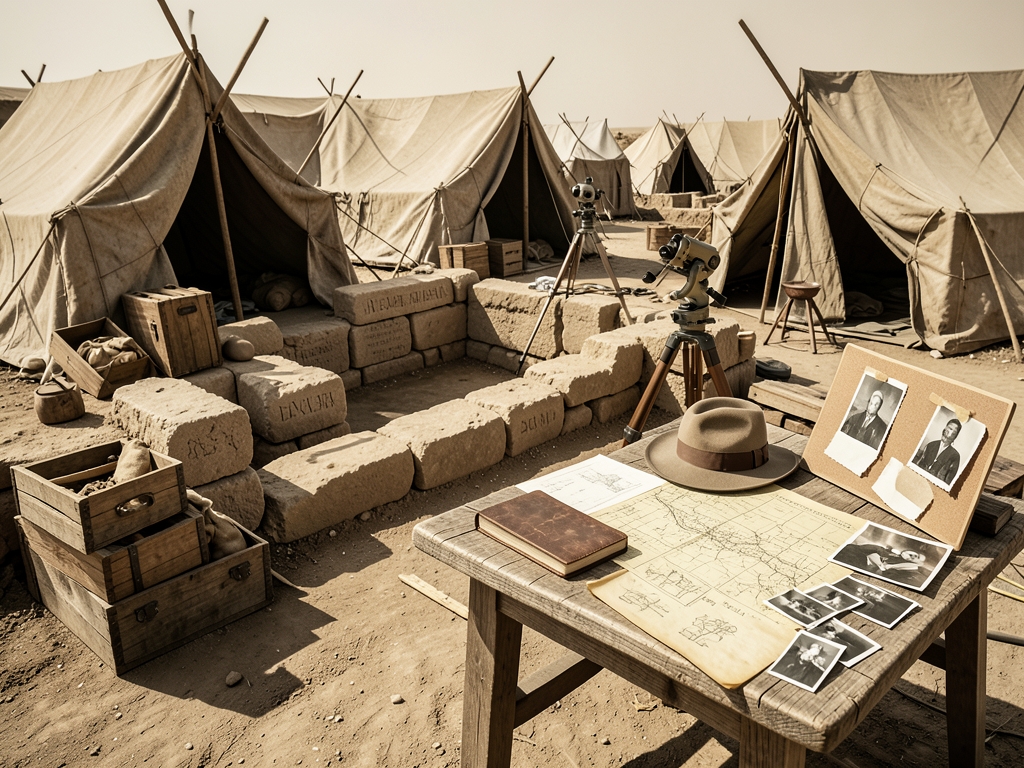
History is filled with shadowy chapters, unresolved enigmas, and cold cases that stretch across generations, baffling historians and investigators alike. Among these enduring puzzles, few resonate as deeply within the academic community as the tragic and untimely death of British archaeologist James Starkey. Gunned down on a lonely desert road in Mandatory Palestine in January 1938, Starkey left behind an incomplete excavation at the biblical site of Tell ed-Duweir—ancient Lachish—and a grieving family. For nearly nine decades, the exact circumstances, motives, and identities behind his assassination remained clouded in rumor, local politics, and sparse official documentation. However, recent archival discoveries have begun to pierce through the fog of time, shedding illuminating light on an 88-year-old mystery that has haunted Middle Eastern archaeology for generations.
To fully grasp the magnitude of the mystery and the significance of the newly surfaced records, one must look back at the golden age of Levantine archaeology during the interwar period. James Starkey was not merely a field digger; he was a visionary scholar whose meticulous stratigraphic methods revolutionized how archaeologists approached ancient mounds. Working under the auspices of the Wellcome-Marston Archaeological Research Expedition, Starkey directed the excavation of Lachish, a massive and historically rich site in southern Palestine. His work was uncovering critical links between biblical history and material culture, unearthing the famous Lachish Letters—inscribed potsherds that provided priceless insights into the final days of the Kingdom of Judah before the Babylonian conquest. Yet, as Starkey labored beneath the relentless sun to preserve antiquity, the modern geopolitical landscape around him was fracturing under intense sectarian violence and anti-colonial resistance.
The Fatal Ambush on the Road to Jerusalem
On January 10, 1938, Starkey boarded a vehicle bound for Jerusalem to attend the formal opening of the Palestine Archaeological Museum, now widely known as the Rockefeller Museum. He was traveling from his camp at Lachish when armed men ambushed his car near the village of Bayt Jibrin. According to contemporary police reports, the vehicle was forced to stop, and Starkey was singled out by the attackers due to his distinct appearance as a prominent European official, while his traveling companions were left unharmed before the assailants fled into the rugged hills. The news of his murder sent shockwaves through British colonial administration, academic institutions across Europe and the United States, and local communities alike. The British authorities launched an immediate and extensive manhunt, detaining several local suspects and offering substantial rewards for information leading to a conviction, yet the case ultimately stalled without a definitive judicial resolution.
In the decades that followed, various theories circulated among historians, biographers, and descendants of the archaeological team. Some accounts attributed the assassination to local bandits capitalizing on the general lawlessness of the Arab Revolt against British rule, while others whispered of political conspiracies, mistaken identity, or targeted retaliation amid escalating tensions between Arab nationalists, Jewish Zionist groups, and the British mandatory government. Because colonial police files were frequently classified, misplaced, or destroyed during the turbulent end of the British mandate in 1948, researchers lacked access to primary investigative records, leaving the tragedy wrapped in speculative folklore. The absence of concrete paper trails allowed myths to proliferate, obscuring the human reality behind the historical event and preventing closure for those seeking to understand why a brilliant scholar’s life was cut short in his prime.
Archival Records and Modern Historical Reassessment
The recent emergence and re-examination of long-forgotten archival records have fundamentally changed the analytical framework surrounding Starkey's death. Modern archivists and historians, utilizing newly cataloged colonial police logs, confidential correspondence between British district commissioners, and previously unstudied diplomatic dispatches, have managed to cross-reference witness testimonies that were discounted or ignored in the chaotic aftermath of 1938. These records indicate that while the general security situation during the Arab Revolt provided the operational cover for the attack, Starkey may have been caught in a complex web of local retaliatory politics tied to land disputes and labor grievances in the surrounding countryside, rather than a targeted assault against archaeology itself.
Furthermore, the archival material highlights the frantic behind-the-scenes diplomatic maneuvering between British officials in Jerusalem and London, who feared that prosecuting or publicizing certain local actors might ignite wider regional uprisings. This institutional hesitation created a judicial vacuum, resulting in incomplete case files that misled amateur historians for generations. By carefully piecing together these fragmented documents, contemporary researchers are not only clarifying the mechanics of the ambush but also restoring historical nuance to a period marked by profound suffering and political upheaval. The unearthing of these records serves as a powerful reminder that history is never truly finished; it simply waits in dusty vaults for the right tools and inquisitive minds to bring forgotten truths to light.
The Legacy of James Starkey at Tell ed-Duweir
While the mystery of his assassination has dominated biographical discussions, Starkey’s true monument remains the soil of Tell ed-Duweir. Before his life was tragically cut short, he established methodological standards that predated and influenced modern scientific archaeology. His insistence on recording every stratigraphic layer, rather than merely hunting for museum-quality artifacts, preserved the chronological integrity of Lachish. The expedition team he trained continued his work under difficult circumstances, ensuring that his monumental efforts were not entirely lost to the chaos of war and political transition. Today, the legacy of James Starkey endures in every archaeology textbook that references the Lachish Letters and in the ongoing international scholarly interest in southern Levantine history.
| Historical Element | Traditional Narrative | New Archival Insight |
|---|---|---|
| Motive | Random banditry or generalized anti-British violence | Complex local retaliatory dynamics linked to regional disputes |
| Investigation | Hasty colonial closure due to lack of evidence | Suppressed or misfiled witness testimonies revealing specific local actors |
| Impact | Immediate cessation of all regional archaeological work | Temporary suspension followed by resilient continuation of stratigraphy methods |
As historians continue to analyze the newly accessible documents from British and regional archives, the narrative surrounding James Starkey shifts from a sensationalized colonial whodunit into a poignant case study of how individual lives intersect with tumultuous historical epochs. The rediscovery of these records honors his scientific contributions while offering long-overdue clarity on a dark moment in archaeological history. For scholars and enthusiasts alike, solving an 88-year-old mystery is not merely about assigning guilt; it is about restoring dignity, accuracy, and completeness to the historical record of human endeavor and sacrifice.
Who was James Starkey and why was he famous?
James Starkey was a prominent British archaeologist who directed the excavation at Tell ed-Duweir, ancient Lachish, in Mandatory Palestine during the 1930s. He revolutionized stratigraphic excavation techniques and discovered the famous Lachish Letters.
When and where was James Starkey killed?
Starkey was ambushed and killed on January 10, 1938, on a desert road near the village of Bayt Jibrin while traveling from his excavation site to Jerusalem.
What new information have recent archival records revealed?
Recent archival finds include previously classified colonial police logs and confidential correspondence that shed light on local political dynamics, witness testimonies, and the reasons behind the original investigation's stall.
