

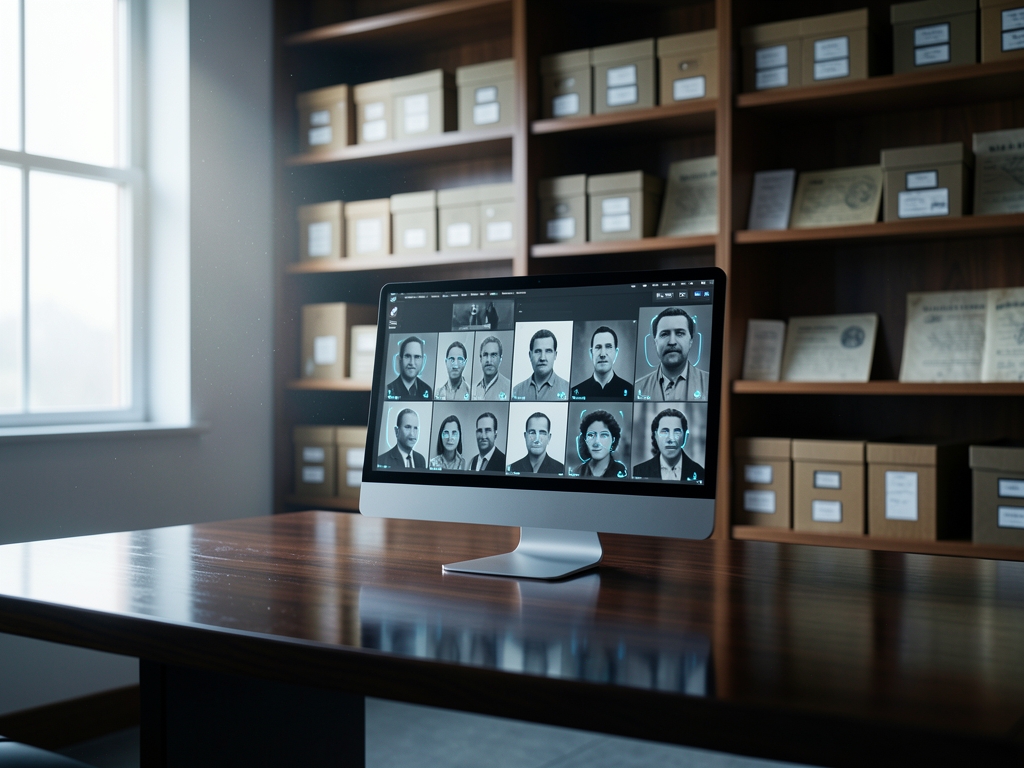
The painstaking process of historical documentation has entered a transformative new phase, bringing long-awaited closure to families whose histories were fractured by the darkest chapters of the twentieth century. At Yad Vashem, the World Holocaust Remembrance Center, advanced artificial intelligence is now being deployed to solve a heartbreaking archival challenge: matching thousands of anonymous historical photographs with the actual names of individuals who lived, suffered, and perished during the Holocaust. This technological breakthrough is not merely an exercise in data processing; it represents a profound restoration of individual identity to human beings who were systematically stripped of their names by a regime dedicated to total erasure.
For decades, historians, archivists, and grieving descendants have stared at fading photographic prints recovered from displaced persons camps, liberation archives, and personal collections. These images captured faces filled with dignity, fear, resilience, and fleeting moments of daily life, yet the accompanying records frequently lacked identifying labels. Traditional manual cross-referencing methods, reliant on human memory and laborious paper-based cross-checks, could only achieve so much before hitting insurmountable bottlenecks. Today, however, sophisticated machine learning models designed specifically for archival facial analysis are bridging the decades, comparing archival imagery against vast digital databases of names, transport lists, and testimony records with unprecedented speed and accuracy.
The Scale of the Archival Challenge
The sheer magnitude of the photographic record preserved at Yad Vashem and other international institutions is staggering. Millions of documents, diaries, and individual photographs survived the wreckage of World War II, scattered across dozens of countries and institutional vaults. While digitization efforts over the last twenty years successfully brought these visual records online, making them accessible to global researchers, a critical deficit remained. An unnamed photograph of a child in a ghetto or a family gathering in a European village before the war remained a silent artifact—powerful, yet fundamentally incomplete in its historical testimony.
Archivists faced a race against time. The generation of survivors and direct witnesses who might have looked at these photographs and recognized a cousin, a neighbor, or a classmate is rapidly passing away. Without intervention, thousands of faces risked remaining permanently anonymous, locked in historical limbo. The integration of specialized artificial intelligence tools into the Yad Vashem workflow addresses this urgency directly, serving as a digital bridge connecting surviving visual evidence with surviving textual records.
| Archive Phase | Traditional Method | AI-Powered Approach |
|---|---|---|
| Initial Ingestion | Manual scanning and cataloging | High-resolution automated OCR and indexing |
| Facial Recognition | Visual inspection by human archivists | Algorithmic landmark mapping and database matching |
| Verification | Paper-based cross-referencing | Multi-source corroboration via testimony and transport lists |
| Public Access | On-site reading room requests | Global digital search portals for descendants |
How Facial Recognition and AI Match Historical Records
Applying modern artificial intelligence to historical photography presents unique technical hurdles that differ significantly from contemporary facial recognition use cases. Historical images are frequently damaged, underexposed, scratched, or captured from unconventional angles using mid-twentieth-century camera technology. Furthermore, subjects in these photographs span all ages, from infants to the elderly, and often endured severe physical trauma, malnutrition, and stress that altered their facial structures over time.
To overcome these obstacles, engineers and archivists developed specialized algorithms capable of looking beyond surface imperfections. Rather than relying on simple pixel matching, the AI models analyze geometric relationships between facial landmarks—such as the distance between the eyes, the structure of the jawline, and the proportions of the nose and cheekbones. These extracted features are then cross-referenced against Yad Vashem's extensive Pages of Testimony database, which contains millions of individual biographical submissions compiled by family members and survivors in the decades following the war.
Info! The AI system does not make definitive identifications autonomously; instead, it generates ranked probability matches that are rigorously reviewed by trained historical researchers before any name is officially linked to a photograph.
This hybrid methodology ensures historical accuracy while preventing false positives. Human expertise remains the ultimate arbiter of truth, guiding the computational engine and verifying contextual clues such as geographic origin, clothing styles, and associated documents found within the same archival collections.
Restoring Dignity and Personal Identity
The emotional and historical impact of these successful matches extends far beyond academic circles. For descendants searching for traces of their ancestry, discovering a named photograph provides a tangible connection to relatives they never had the opportunity to meet. For years, family history research regarding the Holocaust was frequently characterized by an overwhelming sense of absence—empty spaces in family trees where entire branches were abruptly terminated.
When an AI tool successfully matches a face with a name, it actively reclaims that individual from the statistics of mass murder, restoring their specific place within human history. Families scattered across the United States, Europe, Israel, and other parts of the world are increasingly utilizing these enhanced digital archives to piece together lost narratives. Each identified face transforms an abstract historical tragedy into a personal story of mothers, fathers, siblings, artists, students, and workers whose lives possessed inherent value and enduring significance.
Broader Implications for Global Historical Preservation
The success of the initiative at Yad Vashem marks a watershed moment for archival science globally. Major institutions, including national libraries, museums, and historical societies around the world, are closely watching how artificial intelligence can be safely and ethically integrated into heritage preservation. The techniques refined in matching Holocaust photographs are already inspiring parallel projects in other fields, from identifying unknown soldiers in military archives to cataloging historical immigration records.
Warning! Implementing AI in archival workflows requires stringent data governance and ethical oversight to protect sensitive personal information and ensure respectful representation of vulnerable historical populations.
As computational power increases and algorithms become more adept at processing degraded historical media, the boundary between forgotten past and accessible knowledge continues to recede. Institutions are discovering that technology, when guided by rigorous ethical standards and deep historical empathy, can help heal historical fractures that previously seemed insurmountable.
How does the AI tool at Yad Vashem match anonymous photographs with names?
The AI system analyzes geometric facial landmarks from historical images and cross-references them against extensive digital databases, including Yad Vashem's Pages of Testimony and transport lists, to generate verified probability matches.
Are all AI-generated matches published automatically?
No. Every potential match generated by the algorithm undergoes rigorous manual review by trained historical researchers and archivists to ensure absolute accuracy before it is officially linked to an individual's name.
What makes matching historical Holocaust photos particularly difficult?
Historical photos are often damaged, faded, underexposed, or taken with older cameras. Additionally, subjects frequently experienced severe physical stress and trauma that altered their appearance, requiring specialized algorithms designed for degraded media.
How can families search for their relatives in the Yad Vashem archives?
Descendants and researchers can access Yad Vashem's online databases and digital search portals globally to explore digitized documents, photographs, and newly matched records free of charge.
Conclusion
The integration of advanced artificial intelligence into the archival collections at Yad Vashem represents a profound convergence of modern technology and historical stewardship. By successfully matching thousands of previously anonymous photographs with verified names, this initiative does much more than update a database—it restores individual identity, honors the memory of those who perished, and provides grieving descendants with vital connections to their family heritage. As digital preservation techniques continue to evolve, projects like this demonstrate that technology can serve as a powerful instrument of remembrance, ensuring that the human stories of the past are never lost to time.
