

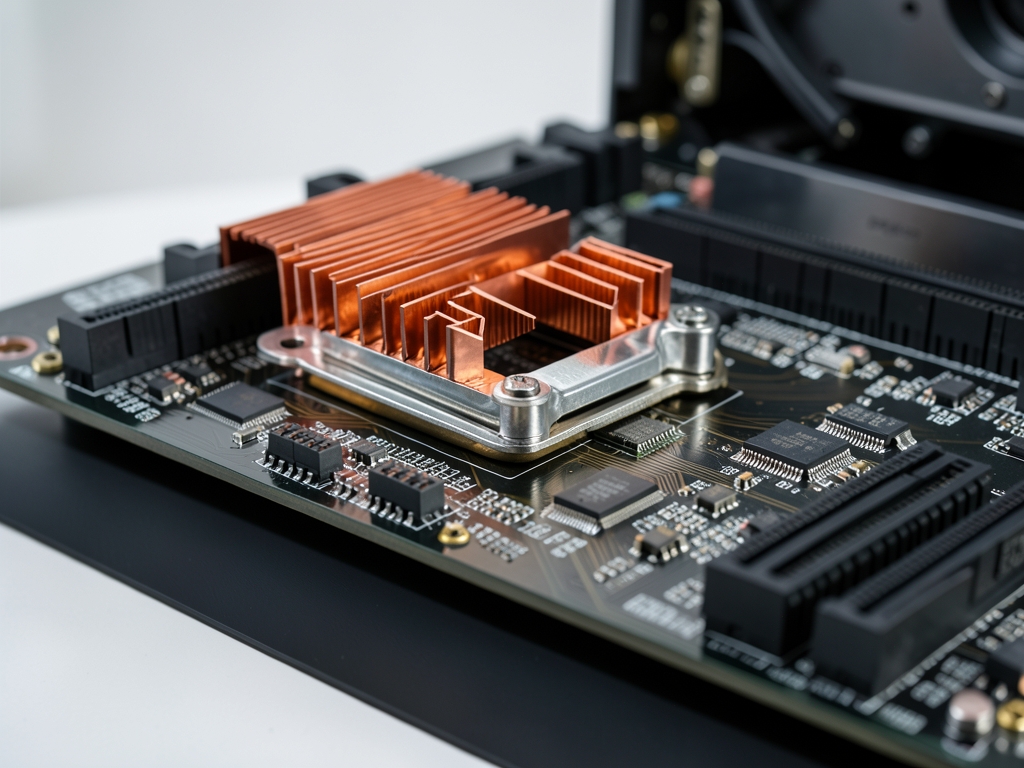
The landscape of local artificial intelligence computing is undergoing a profound structural shift. For years, running large-scale language models with hundreds of billions of parameters was strictly the domain of enterprise-grade cloud data centers equipped with expensive multi-GPU accelerators. Consumer hardware faced severe memory bottlenecks, limiting local deployments to smaller quantized models that often sacrificed reasoning depth and factual precision. However, recent hardware announcements indicate that the dividing line between enterprise servers and high-end desktop computing is rapidly blurring.
Advanced silicon architectures designed for unified memory allocation are transforming what is possible on local workstations. By integrating massive memory pools directly into advanced processing packages, hardware manufacturers are unlocking capabilities that were previously unimaginable outside of specialized server racks. This evolution is reshaping how developers, researchers, and power users interact with generative artificial intelligence models, enabling complete local execution without reliance on external cloud APIs or continuous internet connectivity.
Understanding the Architectural Leap in Consumer AI Silicon
At the core of this hardware revolution is the fundamental restructuring of processor memory interfaces and high-speed data interconnects. Traditional consumer processors rely on separate system memory and dedicated graphics memory, creating data transfer bottlenecks that slow down large model inference. When an artificial intelligence model processes tokens, it must constantly move weights between system RAM and processor caches. As model sizes scale into the hundreds of billions of parameters, these transfer speeds dictate overall system responsiveness.
Modern system-on-chip designs and unified memory architectures eliminate these traditional boundaries. By providing high-bandwidth memory pools directly accessible to both processing cores and specialized neural accelerators, hardware designers can load massive model weights entirely into high-speed memory. This architectural approach minimizes latency and maximizes throughput, allowing complex models to generate text, analyze code, and process multi-modal inputs at speeds that rival entry-level cloud instances.
The convergence of high-capacity memory and dedicated neural processing on consumer motherboards represents a watershed moment for local machine learning development, privacy preservation, and offline execution capabilities.
Furthermore, power efficiency has become a critical design metric. Traditional enterprise GPUs consume vast amounts of electrical power and require specialized liquid cooling or industrial data center airflow. Consumer-oriented silicon achieving comparable memory bandwidth must operate within standard thermal envelopes typical of high-end desktop towers. Achieving high performance per watt requires sophisticated power gating, optimized instruction sets, and advanced lithography nodes that pack billions of transistors into tighter spaces.
The Significance of 192GB Capacity for 300B Parameter Models
Model parameter size dictates the complexity and nuance a neural network can capture. Models hovering around seven to seventy billion parameters excel at general tasks but frequently struggle with specialized domain knowledge, complex multi-step reasoning, and nuanced contextual understanding. Conversely, models reaching three hundred billion parameters offer vastly superior reasoning capabilities, deep linguistic comprehension, and advanced coding proficiency.
Info! Running a 300-billion parameter model locally requires substantial memory capacity just to hold the raw weights in floating-point or efficiently quantized formats.
With memory configurations reaching up to 192GB on advanced consumer platforms, users can comfortably load and execute models in the 300B range using modern quantization techniques such as 4-bit or 5-bit precision. This capacity ensures that the entire model resides within high-speed memory rather than spilling over to slower storage drives. The elimination of disk-swapping during inference is the single most critical factor in achieving usable tokens-per-second generation rates for ultra-large models.
To understand the scaling requirements of modern language models, consider the following comparative breakdown of memory allocation across different parameter tiers:
| Model Parameter Size | Unquantized (16-bit) RAM Required | Quantized (4-bit) RAM Required | Target Hardware Class |
|---|---|---|---|
| 7 Billion | ~14 GB | ~5 GB | Standard Laptops & Mid-Range GPUs |
| 70 Billion | ~140 GB | ~38 GB | High-End Workstations & Dual GPUs |
| 300 Billion | ~600 GB+ | ~160 - 192 GB | Ultra-High-End Workstations & Specialized Silicon |
Privacy, Security, and Enterprise Implications
Beyond raw performance and model capacity, local execution offers undeniable security and privacy advantages. Enterprises dealing with proprietary source code, confidential financial data, or sensitive healthcare records often face strict compliance hurdles when transmitting data to third-party cloud-based artificial intelligence providers. Cloud inference inherently involves sending data packets across external networks, opening potential vectors for interception or unauthorized data retention.
Running large models locally on high-capacity consumer silicon ensures that all data processing, prompt engineering, and output generation occur entirely within an isolated hardware environment. Nothing leaves the local machine unless the user explicitly chooses to transmit it. This air-gapped security model is invaluable for financial institutions, legal practices, medical researchers, and government agencies operating under stringent regulatory frameworks.
Additionally, local execution eliminates vulnerability to cloud provider service outages, sudden pricing tier changes, or unexpected rate limits. Developers can iterate rapidly on custom prompts, fine-tuned weights, and specialized agentic workflows without incurring recurring API subscription costs. While initial hardware investments for high-capacity systems are substantial, the long-term operational predictability offers significant financial advantages for dedicated development teams.
Practical Considerations for Setting Up a High-Memory AI Workstation
Configuring a desktop system capable of running massive models requires careful attention to component selection, power delivery, and thermal management. Simply purchasing high-capacity memory is insufficient if the motherboard traces, memory controller, and power supply units cannot sustain prolonged workloads under maximum thermal load.
- Verify motherboard compatibility and BIOS support for high-density memory modules before purchase.
- Ensure the power supply unit provides ample wattage and stable voltage rails to prevent system instability during sustained inference tasks.
- Implement robust chassis airflow or liquid cooling solutions to maintain optimal operating temperatures for both the processor and memory heatsinks.
- Configure operating system virtual memory settings and allocate appropriate driver parameters to maximize tensor core utilization.
- Test model loading incrementally, starting with smaller quantized variants before moving to full-scale 300B parameter deployments.
Thermal throttling remains one of the primary performance inhibitors in high-density computing environments. When processors and memory controllers operate near maximum capacity for hours during batch processing or model fine-tuning, heat accumulation can force clock speeds downward. Investing in high-quality thermal interface materials and well-ventilated chassis designs ensures sustained peak performance without unexpected slowdowns.
Warning! Exceeding recommended thermal limits during continuous neural network inference can lead to system crashes, data corruption, or premature hardware degradation.
Software Ecosystem and Optimization Frameworks
Hardware capability is only as effective as the software stack that harnesses it. The open-source community and major silicon vendors have invested heavily in optimizing inference engines for unified memory architectures. Frameworks like llama.cpp, Ollama, and specialized PyTorch extensions now feature native optimizations designed to leverage large contiguous memory pools efficiently.
These optimization layers dynamically manage tensor allocation, execution graph compilation, and kernel fusion, minimizing overhead and maximizing the utilization of available arithmetic logic units. Furthermore, advancements in quantization algorithms allow developers to compress model weights with minimal perplexity loss, fitting larger models into tighter memory constraints without noticeable degradation in output quality.
As software toolchains mature, the barrier to entry for deploying complex multi-agent systems and large language models locally continues to drop. Developers no longer need extensive systems engineering expertise to configure distributed cluster environments; instead, powerful multi-hundred-billion parameter models can be deployed on a single desktop machine with a few simple command-line instructions.
What makes 192GB memory capacity significant for AI models?
A 192GB memory capacity allows users to load and run quantized large language models containing up to 300 billion parameters directly on local consumer hardware without relying on cloud services.
Do I need a separate dedicated GPU to run large models locally?
With unified memory architectures and high-bandwidth system RAM integrated directly into advanced processors, modern high-end desktop silicon can handle large model inference efficiently without requiring multiple discrete GPUs.
Why is local AI execution preferred for sensitive enterprise data?
Local execution ensures that proprietary code, financial records, and confidential documents never leave the physical machine, eliminating external network transmission risks and satisfying strict data privacy compliance standards.
What is model quantization and why is it necessary?
Quantization reduces the precision of model weights from 16-bit to lower bit-rates like 4-bit, drastically reducing memory requirements and enabling massive models to fit into consumer hardware memory pools.
Conclusion
The introduction of high-capacity consumer silicon capable of managing 192GB of memory and executing 300B parameter models marks a definitive turning point in personal and enterprise computing. By bridging the performance gap between local workstations and enterprise cloud infrastructure, these advancements democratize access to state-of-the-art artificial intelligence capabilities. Whether for enhanced data privacy, offline operational resilience, or rapid experimentation, high-memory consumer hardware empowers developers and organizations to push the boundaries of what is possible on local machines.
