

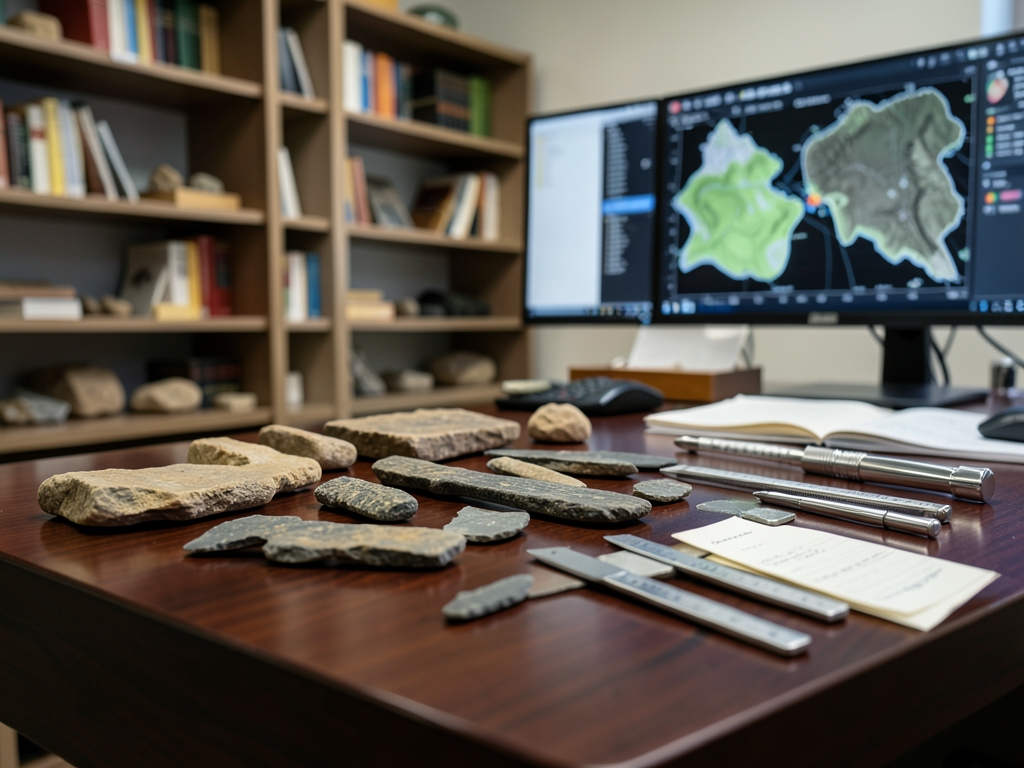
Archaeological research has long relied on the silent testimony of physical artifacts to piece together the grand narrative of human history. For decades, experts have studied weapons, pottery, and dwellings to understand how ancient populations spread across continents, adapted to shifting environments, and interacted with neighboring groups. Recently, a team of Israeli researchers has brought new clarity to this endeavor by applying advanced analytical techniques to ancient stone tools. This innovative approach allows scientists to trace hunter-gatherer migrations with unprecedented precision, offering a vivid window into the daily lives, movement patterns, and survival strategies of early human societies.
Understanding the pathways taken by prehistoric populations is essential for mapping the spread of human culture and technological innovation. Traditionally, archaeologists depended on stratigraphic dating and typological classification to sequence archaeological sites. While these methods remain foundational, they often leave significant gaps in our understanding of fine-grained mobility. By examining the microscopic wear patterns, raw material sourcing, and manufacturing techniques inscribed on ancient stone implements, modern researchers can reconstruct the exact journeys of ancient groups who roamed across vast prehistoric landscapes.
The Significance of Stone Tools in Prehistoric Mobility
Stone tools represent the most durable and abundant category of material culture recovered from prehistoric sites. Unlike organic materials such as bone, wood, or textiles, which typically decay over thousands of years, flint, obsidian, and quartzite artifacts endure indefinitely. Every flake struck from a core, every edge sharpened for butchery, and every projectile point fashioned for hunting carries indelible evidence of the artisan's intent and technical repertoire.
For hunter-gatherer societies, mobility was not merely a lifestyle choice but an absolute ecological necessity. These groups depended on seasonal availability of game animals, edible plants, and reliable water sources. As resources shifted with climatic fluctuations, human groups packed their belongings and moved across geographical boundaries. Because stone tools were vital for daily survival, they were constantly manufactured, maintained, and eventually discarded along migration routes. Consequently, tracking the geological origin of the raw materials used to create these tools provides a direct chemical and mineralogical fingerprint of human movement.
Methodologies Behind Modern Lithic Analysis
The recent study conducted by Israeli researchers employs a multidisciplinary framework that combines traditional archaeology with high-resolution geoscientific testing. Rather than relying solely on visual inspection, the research team utilized petrographic analysis, X-ray fluorescence spectrometry, and 3D geometric morphometrics to characterize the stone assemblages.
- Petrographic Analysis: Thin-section microscopy allows geologists to identify the specific mineral composition and microfossils embedded within flint artifacts, matching them precisely to geological source outcrops.
- X-ray Fluorescence (XRF): This non-destructive elemental analysis determines the chemical signature of raw materials without damaging fragile archaeological specimens.
- Use-Wear Analysis: High-powered microscopic examination reveals microscopic polish, striations, and micro-fractures left behind by specific activities such as hide scraping, meat cutting, or wood working.
- 3D Morphometrics: Advanced digital scanning captures the precise shape and symmetry of lithic artifacts, illuminating cultural traditions passed down across generations.
By integrating these analytical streams, the researchers can determine whether a group traveled with pre-made toolkits, acquired raw stone through regional trade networks, or foraged for local materials upon arriving in new territories. This level of granularity transforms static stone artifacts into dynamic indicators of prehistoric behavior.
Mapping the Landscapes of the Levant
The geographic focus of the research centers on the Levant, a critical crossroads connecting Africa, Asia, and Europe. Throughout prehistory, this region served as a primary corridor for hominin dispersal and cultural exchange. The varied topography—ranging from coastal plains and fertile river valleys to arid deserts and rugged mountain ranges—provided diverse ecological niches that challenged hunter-gatherer adaptability.
The recent findings demonstrate that ancient groups operating within this corridor possessed sophisticated spatial awareness and long-range mobility networks. Rather than wandering aimlessly, these populations maintained habitual travel circuits that connected specialized resource camps. Stone artifact distribution maps indicate that certain groups regularly transported high-quality flint over distances exceeding fifty kilometers, bypassing alternative local sources in favor of preferred materials with superior knapping qualities.
Furthermore, changes in tool manufacture techniques observed across different stratigraphic layers reflect adaptive shifts in response to environmental drying periods. When traditional hunting grounds contracted due to climate change, groups modified their stone toolkits to improve foraging efficiency, creating smaller, more versatile composite tools that could be easily repaired and transported.
Info! The Levant serves as a key natural laboratory for archaeologists because overlapping migration pulses left behind densely layered deposits spanning multiple millennia of human evolution.
Implications for Broad Human Evolution Models
The ability to trace hunter-gatherer migrations with such high fidelity has profound implications for broader anthropological models. For many years, debates persisted regarding whether cultural innovations spread primarily through the physical migration of human populations (demic diffusion) or through the transmission of ideas between stationary groups (cultural diffusion). By linking specific technological traditions directly to imported raw materials, the Israeli study offers concrete empirical evidence for actual human movement across specific geographic corridors.
Additionally, these insights shed light on social networks and territorial interactions among prehistoric bands. The distribution of distinct stone tool styles suggests that separate hunter-gatherer communities maintained active exchange relationships, sharing not only physical materials but also technical knowledge and artistic traditions. Such networks likely played a vital role in reducing demographic vulnerability and maintaining genetic diversity within small, isolated populations.
Challenges in Prehistoric Interpretation
Despite the sophisticated tools available to modern researchers, interpreting the archaeological record remains complex and fraught with potential pitfalls. Preservation bias represents a major hurdle; sites located in open-air environments are frequently disturbed by natural erosion, agricultural activity, and modern development. Furthermore, distinguishing between intentional human transport of stone materials and natural geological displacement by rivers or flash floods requires rigorous geological verification.
Every stone tool is a frozen moment of human cognition, encapsulating both the environmental constraints of the landscape and the ingenious solutions devised by ancient artisans.
Researchers must also account for recycling and reuse. Prehistoric humans frequently scavenged older archaeological sites to harvest abandoned tools, reworking them into new forms. This practice can complicate chronological sequences and geographical tracing if analysts fail to distinguish between original manufacture events and secondary modification phases.
Future Directions in Lithic Research
As analytical technologies continue to evolve, the future of archaeological science looks exceptionally promising. Emerging non-destructive techniques will allow researchers to analyze even smaller fragments of stone and organic residue trapped on tool surfaces. Residue analysis, in particular, holds great potential for identifying ancient blood proteins, plant starches, and adhesives used in hafting, providing a direct link between the stone tool and the specific task it performed.
Collaborative international databases are also transforming the field. By pooling chemical characterization data from numerous regional studies, archaeologists can construct comprehensive GIS-based maps of raw material distribution networks across entire continents. These digital archives will enable future generations of scientists to track prehistoric migration highways with unprecedented spatial and temporal resolution.
How do researchers determine where ancient stone tools came from?
Researchers use petrographic analysis and X-ray fluorescence spectrometry to examine the mineral composition and chemical signatures of stone artifacts, matching them precisely to known geological source outcrops.
Why are stone tools more reliable than bones for tracing migrations?
Stone materials like flint and quartzite are highly durable and resist decay over thousands of years, whereas organic remains like bone and wood typically decompose rapidly in most soil environments.
What role did the Levant play in prehistoric human movement?
The Levant served as a vital geographical bridge connecting Africa, Asia, and Europe, functioning as a primary corridor for hominin dispersal, cultural exchange, and seasonal hunter-gatherer mobility.
Can stone tool analysis distinguish between migration and cultural exchange?
Yes. By combining raw material sourcing with manufacturing technology analysis, researchers can differentiate between the physical movement of human groups carrying their tools and the mere spread of ideas through trade.
The recent work by Israeli researchers highlights the extraordinary power of combining rigorous scientific analysis with classic archaeological excavation. By extracting intricate details from ancient stone implements, science continues to illuminate the remarkable journeys, resilience, and adaptability of early human societies as they shaped the foundations of our shared global history.
