

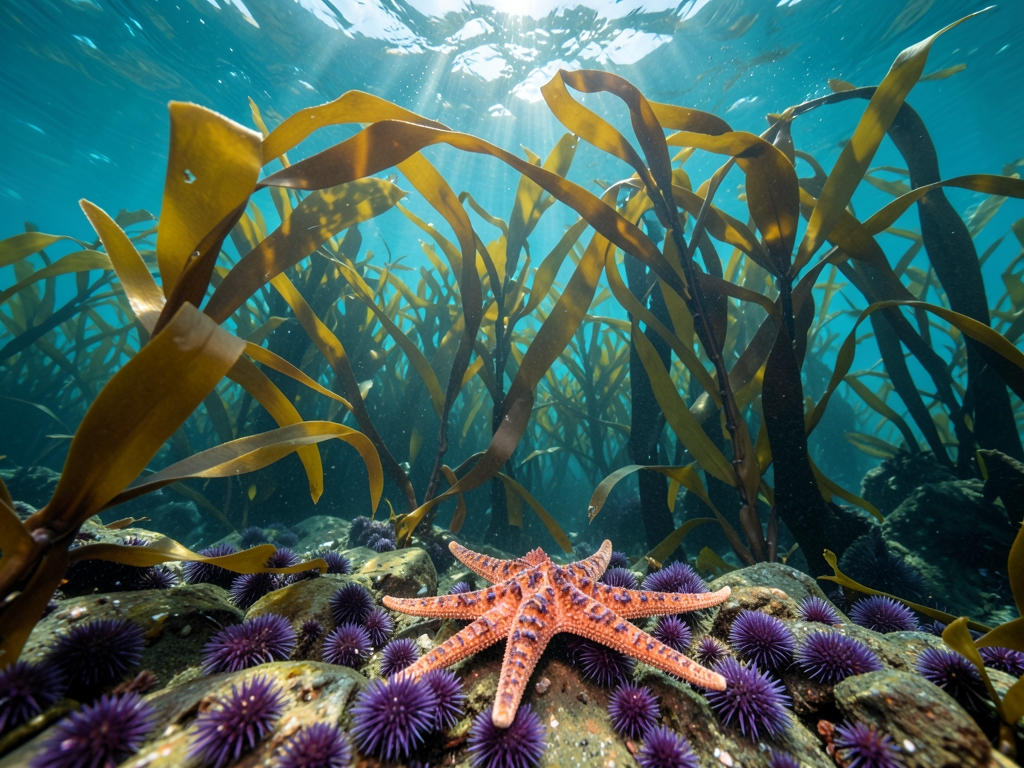
Off the rugged coast of California, one of the ocean's most vital and productive ecosystems has faced an unprecedented environmental crisis over the past decade. Towering underwater kelp forests, which once stretched for miles along the Pacific shoreline and provided essential habitats for countless marine species, experienced catastrophic collapses following a compounding series of ecological shocks. Unusually warm ocean anomalies combined with a devastating wasting disease that decimated native predator populations, triggering an explosion of voracious purple sea urchins. These herbivores rapidly overgrazed the living kelp, transforming vibrant underwater canopies into barren underwater deserts devoid of complex life.
To combat this ecological collapse, marine biologists and conservation researchers have turned to an unexpected biological ally: a multi-armed predator capable of shifting the balance back in favor of marine recovery. Recent field initiatives have highlighted the deployment of the sunflower sea star, a striking multi-limbed echinoderm that serves as a keystone predator in temperate coastal waters. Understanding how these unique organisms function, why their populations crashed, and how scientific intervention is attempting to rebuild damaged kelp habitats offers vital insights into modern marine conservation strategies.
The Ecological Importance of Coastal Kelp Forests
Kelp forests are among the most dynamic, productive, and biologically diverse habitats on planet Earth. Composed primarily of giant kelp and bull kelp species, these massive brown macroalgae grow at astonishing rates under optimal conditions, sometimes stretching up to two feet per day. They form complex three-dimensional underwater landscapes that rival terrestrial rainforests in their ability to support diverse marine life.
From commercially vital fisheries like rockfish and abalone to microscopic invertebrates, hundreds of species rely directly on kelp forests for shelter, nursery grounds, and primary food sources. Beyond local biodiversity, these marine ecosystems play a crucial role in global carbon cycling. Fast-growing kelp absorbs significant amounts of carbon dioxide from the surrounding water, locking away carbon when fragments break off and sink into the deep ocean basins. Furthermore, extensive kelp canopies help mitigate coastal erosion by dampening powerful wave energy before it reaches fragile shorelines.
Despite their resilience, these ecosystems remain highly vulnerable to rapid environmental shifts. When a single link in the predator-prey chain breaks, the entire structural integrity of the kelp forest can unravel in a matter of months, leaving behind expansive 'urchin barrens' where few other organisms can survive.
The Catalyst of Collapse: Disease and Warming Waters
The widespread degradation of California’s kelp canopy did not happen overnight. It was triggered by a combination of large-scale climatic anomalies and catastrophic disease outbreaks that swept across the Northeast Pacific starting around 2013 and 2014. A massive marine heatwave, colloquially referred to by oceanographers as 'The Blob,' elevated water temperatures significantly across vast stretches of the coast.
Simultaneously, a devastating marine plague known as Sea Star Wasting Syndrome emerged with unprecedented virulence. This syndrome affected multiple echinoderm species, but its impact on the sunflower sea star was catastrophic. The disease causes rapid tissue decay, limb detachment, and eventual mortality, wiping out an estimated ninety percent or more of sunflower sea star populations across their historical range from Alaska down to Baja California.
Without their primary predator to keep them in check, purple sea urchin populations exploded exponentially. Released from ecological pressure, dense herds of urchins scoured the rocky reefs, consuming every holdfast and frond of giant kelp in their path. Because starving urchins can survive in a dormant metabolic state for years inside barren zones, natural recovery became virtually impossible without active intervention.
The Twenty-Four-Armed Secret Weapon
Enter the sunflower sea star, scientifically known as Pycnopodia helianthoides. Unlike typical starfish species that possess five arms, mature sunflower sea stars can boast anywhere from sixteen to twenty-four flexible arms radiating from a central disk. This unique physiological structure allows them to move with surprising speed across complex rocky terrain and capture agile prey.
In a healthy marine ecosystem, the sunflower sea star acts as an apex invertebrate predator. While they consume a variety of benthic organisms, their preferred and most impactful prey is the sea urchin. When a sunflower sea star glides across an urchin barren, the mere scent of the predator often causes nearby urchins to flee in frantic behavioral displays. When contact is made, the sea star uses its numerous arms and powerful tube feet to envelop and consume the herbivore, effectively disrupting the destructive grazing pressure that maintains the barren state.
Recognizing the irreplaceable ecological role of Pycnopodia helianthoides, conservation scientists, academic institutions, and government agencies have initiated ambitious captive-breeding programs and carefully monitored reintroduction trials to restore populations to targeted coastal zones.
Restoring keystone predators like the sunflower sea star provides a natural, self-sustaining mechanism to control herbivorous pressure and allow foundational kelp habitats to regenerate organically.
Scientific Breeding and Reintroduction Challenges
Breeding sunflower sea stars in controlled laboratory environments presents significant logistical and biological challenges. Marine biologists must carefully replicate complex ocean conditions, including precise temperature controls, pristine water quality, and specific nutritional inputs during the delicate larval stages. Because larval sea stars spend weeks drifting as plankton before settling onto the benthos, securing high survival rates requires meticulous hatchery management.
Info! Captive breeding breakthroughs have allowed marine institutes in California and Washington to successfully raise thousands of juvenile sunflower sea stars, marking a major milestone for endangered marine invertebrate conservation.
Once individuals reach a robust juvenile or sub-adult size, scientists execute carefully planned reintroduction protocols. Researchers select optimal micro-habitats with adequate shelter and food availability, monitoring the introduced stars using underwater telemetry, tagging, and periodic diving surveys. Initial observations indicate that reintroduced predators immediately begin foraging on local urchin populations, triggering localized behavioral changes among grazers and granting young kelp spores a critical window to germinate and grow.
Broader Marine Management and Ecosystem Resilience
While reintroducing Pycnopodia helianthoides represents a monumental step forward, conservationists emphasize that biological restoration must be integrated into broader coastal management frameworks. Addressing long-term climate change impacts, reducing land-based nutrient runoff, and implementing adaptive fisheries management are equally essential to ensure that recovering kelp forests can withstand future environmental shocks.
Furthermore, local diver-led removal efforts—often referred to as 'urchin culling'—are frequently paired with biological restoration to accelerate the immediate clearance of barrens before predator populations have fully rebounded. By combining community-driven manual removal with the strategic release of keystone predators, marine managers are developing a comprehensive blueprint for coastal resilience along the Pacific Rim.
| Conservation Strategy | Primary Mechanism | Ecosystem Impact |
|---|---|---|
| Captive Breeding | Hatchery-based larval and juvenile rearing | Rebuilds depleted genetic diversity and population numbers |
| Targeted Reintroduction | Strategic release of sub-adult sea stars | Restores top-down predation pressure on grazing sea urchins |
| Manual Urchin Culling | Diver-led removal of grazing herbivores | Provides immediate relief and opens space for kelp spore settlement |
| Water Quality Monitoring | Tracking temperature anomalies and nutrient loads | Mitigates secondary stressors affecting young kelp growth |
As these multifaceted conservation projects expand, the return of the twenty-four-armed predator offers a powerful symbol of hope for marine ecosystems worldwide. Proving that complex ecological wounds can sometimes be healed by restoring natural biological relationships, scientists continue to refine their methods to secure a greener, more resilient future for our oceans.
What caused the collapse of California kelp forests?
The collapse was triggered by a combination of marine heatwaves known as 'The Blob' and a devastating outbreak of Sea Star Wasting Syndrome, which wiped out sunflower sea stars and led to an unchecked population explosion of kelp-grazing purple sea urchins.
Why are sunflower sea stars considered keystone species?
Sunflower sea stars are keystone predators because their predation on herbivores like sea urchins directly regulates grazing pressure, allowing kelp forests and their associated biodiversity to thrive.
How do scientists restore sunflower sea star populations?
Scientists use specialized marine hatcheries to breed sunflower sea stars from larvae to juvenile stages, subsequently releasing them into carefully monitored coastal test sites where urchin barrens need ecological intervention.
Can kelp forests recover without human intervention?
In severely degraded urchin barrens where predators are entirely absent and starving urchins persist in dormant states, natural recovery is extremely slow or impossible, making active conservation and predator reintroduction essential.
