

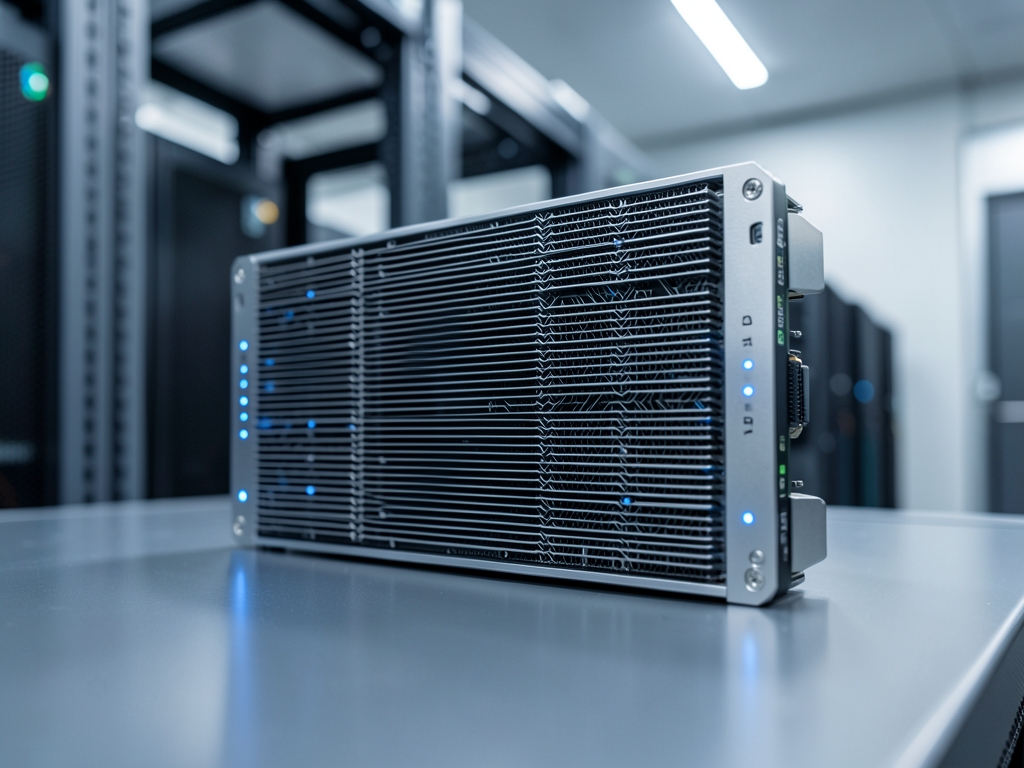
The rapid evolution of artificial intelligence workloads continues to redefine data center architecture, pushing hardware manufacturers to engineer specialized silicon capable of handling massive parallel computations. As generative models and complex machine learning pipelines grow in scale, traditional processing units often face bottlenecks in memory bandwidth and floating-point throughput. Addressing these pressing enterprise demands, Intel officially powered its new GPU D-Series product line with the Crescent Island AI accelerator, marking a significant milestone in high-performance computing infrastructure.
This development arrives as the semiconductor industry races to deliver efficient silicon for data-intensive environments. By combining high-density floating-point compute capabilities with robust memory subsystem architecture, the Crescent Island accelerator aims to support demanding enterprise workflows without requiring sweeping overhauls of existing server topologies. Understanding the technical specifications, architectural features, and practical integration of this new accelerator provides valuable insight into the current trajectory of modern server hardware.
Architectural Overview of the Crescent Island Accelerator
At the core of the Crescent Island AI accelerator lies a specialized processing architecture engineered to maximize throughput while optimizing energy consumption. Modern AI inferencing and training tasks rely heavily on lower-precision arithmetic formats to accelerate execution speeds without sacrificing acceptable model accuracy. The Crescent Island chip delivers up to 1.3 peak PFLOPS of FP8 compute performance, offering a powerful engine for neural network operations that benefit from reduced-precision calculations.
In addition to raw floating-point compute power, memory bandwidth remains a critical determinant of accelerator efficiency. When processing large language models or complex data streams, memory bottlenecks can severely restrict overall system utilization. The Crescent Island accelerator addresses this challenge by delivering 1.5 TB/s of memory bandwidth, ensuring that data feeds rapidly into the compute units. This balanced ratio between compute capability and data transfer speed helps maintain high operational efficiency across multi-node server clusters.
Integration Into the D-Series Product Ecosystem
The official integration of the Crescent Island accelerator into Intel's new GPU D-Series products represents a cohesive hardware strategy designed for enterprise environments. Rather than operating as a standalone co-processor, the accelerator is deeply embedded within the D-Series platform framework, facilitating seamless communication with host processors and surrounding network infrastructure.
Enterprise data centers demand high reliability, scalability, and predictable performance under sustained workloads. The D-Series architecture incorporates robust thermal management designs and standardized physical form factors, allowing system integrators to deploy these accelerators across diverse server rack configurations. Furthermore, compatibility with standard software stacks ensures that developers can transition existing machine learning models to the new hardware platform with minimal friction.
Open Infrastructure and the Agentic AI Era
The introduction of specialized hardware occurs alongside a broader industry shift toward open infrastructure designed to support agentic AI systems. Autonomous software agents and complex multi-model pipelines require flexible, interoperable software frameworks that can coordinate tasks across heterogeneous compute resources. Intel's ongoing efforts to accelerate open infrastructure aim to align hardware accelerators like Crescent Island with open-source software libraries, compilers, and orchestration tools.
By supporting open standards, enterprise customers can avoid vendor lock-in and optimize their infrastructure for specific workloads. Whether deploying large-scale cloud environments or localized enterprise clusters, access to transparent software tools enables developers to fine-tune execution parameters, monitor hardware telemetry, and maximize return on investment for high-density AI deployments.
Enterprise Deployment Considerations and Performance Benchmarks
Deploying high-performance AI accelerators requires careful planning regarding power delivery, thermal dissipation, and rack-level integration. Data center operators must evaluate power usage effectiveness (PUE) when scaling compute clusters to multi-gigawatt levels. The energy efficiency offered by 8-bit floating-point (FP8) compute helps mitigate rising power densities, allowing facilities to achieve higher computational output per square foot.
Balanced memory bandwidth and high-density compute pipelines are essential for eliminating data bottlenecks in modern enterprise AI infrastructure.
When comparing performance metrics against previous generations of enterprise hardware, accelerators featuring high-bandwidth memory and optimized tensor blocks demonstrate substantial improvements in token generation speed and batch processing efficiency. Organizations migrating to the D-Series hardware ecosystem can expect more predictable scaling characteristics when expanding their AI operational capacity.
Practical Guidelines for Evaluating AI Accelerator Hardware
Selecting the appropriate AI accelerator for enterprise infrastructure involves analyzing several technical and operational parameters. Organizations should consider the following factors when reviewing hardware options:
- Examine workload requirements to determine whether FP8, FP16, or higher-precision compute formats are necessary for your specific machine learning models.
- Verify memory bandwidth specifications to ensure the hardware can sustain the data feed rates required by large-scale models.
- Assess server form factor compatibility, power consumption ratings, and thermal design power (TDP) limits within your existing rack infrastructure.
- Review software ecosystem support, including drivers, compilers, and framework integrations, to ensure smooth deployment and optimization.
Info! Enterprise deployments should always validate thermal performance and power distribution units prior to high-density server rack installation.
Future Outlook for Enterprise AI Silicon
The rapid expansion of AI infrastructure points toward a future where specialized accelerators form the backbone of global enterprise computing. As manufacturers continue to refine semiconductor fabrication nodes and interconnect technologies, the performance-per-watt ratio of data center hardware will keep improving. Innovations in memory packaging, such as advanced high-bandwidth memory (HBM) stacking and high-speed coherent interconnects, will further reduce latency across distributed clusters.
Ultimately, hardware announcements like the Crescent Island accelerator and the expansion of D-Series products highlight the competitive nature of the modern semiconductor market. By addressing both compute throughput and memory bandwidth bottlenecks, hardware engineers are laying the groundwork for the next generation of intelligent enterprise applications.
What compute performance does the Crescent Island accelerator deliver?
The Crescent Island AI accelerator delivers up to 1.3 peak PFLOPS of FP8 compute performance.
What is the memory bandwidth of the Crescent Island chip?
The chip provides 1.5 TB/s of memory bandwidth to support data-intensive machine learning workloads.
Which product line is powered by the Crescent Island accelerator?
The accelerator officially powers Intel's new GPU D-Series product line designed for enterprise data centers.
Why is FP8 compute important for modern AI hardware?
FP8 compute enables higher processing speeds and improved energy efficiency for neural network inference and training without significant loss in model accuracy.
As enterprises continue to scale their computing capabilities to meet growing demands, hardware innovations will remain central to digital transformation. Monitoring these technological advancements ensures that organizations can make informed decisions when upgrading their infrastructure for future workloads.
Sources and Further Reading
- Intel's Crescent Island AI accelerator officially powers new GPU D-Series products — chip delivers 1.3 peak PFLOPS of FP8 compute and 1.5 TB/s of memory bandwidth - Tom's Hardware — Tom's Hardware (published 2026-10-12 20:48)
- Intel Accelerates Open Infrastructure for the Agentic AI Era - Intel — Intel (published 2026-10-12 20:29)
