

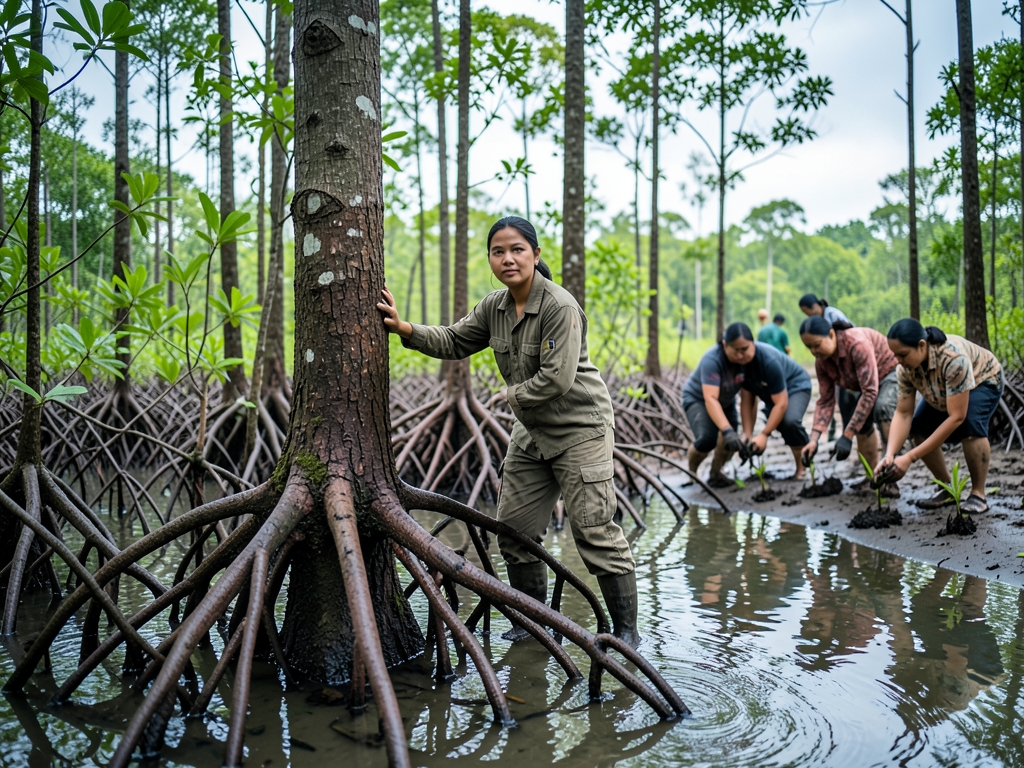
Coastal ecosystems across the tropics serve as critical buffers against marine erosion, storm surges, and the accelerating impacts of global climate change. Among these, mangrove forests occupy a uniquely vital ecological niche, bridging marine and terrestrial realms while sequestering massive amounts of atmospheric carbon in their dense root systems and waterlogged soils. In recent years, community-led ecological initiatives have gained unprecedented recognition for their capacity to restore degraded coastal strips while simultaneously uplifting local populations through sustainable economic development. A prominent example of this integrated model unfolded through grassroots efforts in Indonesia, where youth leadership and women-driven economic empowerment converged to revive fragile coastal habitats.
Understanding the intricate dynamics of mangrove restoration requires examining both biological principles and human geography. Coastal communities often depend directly on marine resources for their livelihoods. When mangrove ecosystems are cleared for aquaculture, coastal development, or timber extraction, local fisheries suffer, shorelines erode rapidly, and communities become intensely vulnerable to tropical storms and rising sea levels. Addressing these compounding crises demands a dual approach: rigorous ecological restoration of native flora and the deliberate creation of sustainable, alternative income streams for local residents, particularly women who frequently manage household economies in rural coastal zones.
The Ecological Significance of Mangrove Forests
Mangroves are salt-tolerant halophytic trees and shrubs that thrive in intertidal zones along tropical and subtropical coastlines. Their tangled, arching root systems—often referred to as prop roots or pneumatophores—create complex structural habitats above and below the water line. These underwater mazes provide indispensable nursery grounds for numerous species of fish, crustaceans, and mollusks, many of which form the backbone of commercial and subsistence fisheries.
Beyond fisheries support, mangroves perform an exceptional ecosystem service known as blue carbon sequestration. Unlike terrestrial forests, where carbon is primarily stored in wood and above-ground biomass, mangroves accumulate vast quantities of organic carbon in their deep, anaerobic underwater soils. This carbon can remain locked away for millennia if the sediment remains undisturbed. Furthermore, the physical barrier presented by dense mangrove thickets effectively dissipates wave energy, reducing coastal flooding and protecting inland human settlements from severe meteorological events.
Grassroots Conservation and Youth Leadership
The success of modern conservation biology increasingly relies on grassroots participation rather than strictly top-down regulatory enforcement. Engaging younger demographics in hands-on environmental stewardship fosters long-term community resilience and instills a deep cultural appreciation for local biodiversity. In many developing coastal regions, youth-led initiatives have successfully mobilized communities to undertake massive reforestation campaigns, transforming barren mudflats and degraded aquaculture ponds back into thriving green belts.
These grassroots projects typically begin with meticulous community mapping and seed collection. Volunteers identify healthy parent trees, harvest mature propagules, and nurture them in community-managed nurseries until the saplings are robust enough to withstand tidal action. Planting initiatives require precise timing, accounting for tidal cycles, seasonal monsoon patterns, and soil salinity levels to ensure high survival rates among the newly introduced flora. When young conservationists spearhead these efforts, they not only restore physical landscapes but also bridge generational knowledge gaps, uniting traditional ecological observations with modern scientific methodologies.
Empowering Local Women Through Sustainable Enterprise
A critical determinant of long-term conservation success is the socioeconomic integration of local women. In many coastal societies, women bear primary responsibilities for daily household management and food security, yet historically faced limited ownership rights or direct participation in environmental resource governance. Integrating women into conservation frameworks changes this dynamic by equipping them with practical skills in sustainable agriculture, ecotourism management, value-added fisheries processing, and nursery operations.
Info! Empowering women in coastal conservation projects ensures that economic benefits are distributed evenly across households, significantly reducing the economic pressures that often drive overfishing and illegal mangrove clearing.
By developing micro-enterprises centered around sustainable forest use—such as honey production from mangrove-foraged nectar, ecotourism guiding, and the cultivation of non-timber forest products—local women generate independent financial resources. This financial autonomy directly correlates with improved community health, higher educational attainment for children, and a heightened commitment to protecting the surrounding natural environment from future degradation.
Challenges in Coastal Wetland Restoration
Despite the inspiring successes of community-led reforestation, large-scale mangrove restoration faces significant obstacles. Ecological restoration is not merely a matter of planting trees; it requires comprehensive hydrological rehabilitation. If a degraded site has been altered by dikes, road construction, or altered drainage channels, newly planted saplings will frequently perish due to incorrect water salinity, stagnant pooling, or inadequate tidal flushing.
Another persistent challenge involves competing land-use pressures. Coastal zones are intensely contested spaces valued by aquaculture corporations, real estate developers, and industrial shipping interests. Balancing commercial economic demands with the imperative of ecological preservation requires robust legal frameworks, transparent land-tenure systems, and active government support to protect restored zones from future encroachment.
| Restoration Factor | Traditional Approach | Community-Integrated Model |
|---|---|---|
| Primary Focus | Solely planting trees | Hydrological repair and socioeconomic uplift |
| Community Role | Passive observers | Active planners and economic beneficiaries |
| Gender Inclusion | Often overlooked | Central to micro-enterprise and management |
| Long-term Viability | Low due to high mortality rates | High due to local stewardship and oversight |
Monitoring and Scientific Assessment
Modern conservation initiatives increasingly incorporate scientific monitoring protocols to measure ecological recovery accurately. Researchers and community scientists utilize drone imagery, GPS mapping, and field surveys to track canopy cover, measure soil organic carbon accumulation, and monitor biodiversity return rates over multi-year timelines. These empirical metrics are essential for validating the effectiveness of restoration projects, securing ongoing philanthropic or governmental funding, and refining planting techniques for future deployment in similar climatic zones.
Furthermore, understanding the microbiome of mangrove sediments has opened new frontiers in ecological research. Scientists analyze bacterial communities within the rhizosphere to determine how soil health recovers following anthropogenic disturbance. Such interdisciplinary approaches ensure that conservation interventions are grounded in sound ecological science rather than purely aesthetic goals.
Restoring coastal wetlands is not just an act of planting trees; it is a profound commitment to stabilizing the planetary climate, protecting vulnerable human settlements, and honoring the intricate ecological interdependence of land and sea.
- Conduct a comprehensive hydrological assessment of the degraded coastal site to evaluate tidal flow and soil salinity.
- Engage local community leaders and women's cooperatives to co-design the restoration and economic livelihood framework.
- Establish community-managed nurseries using locally sourced seeds and resilient native mangrove species.
- Execute coordinated planting drives during favorable seasonal windows, followed by continuous monitoring and maintenance.
Global Implications and Policy Recommendations
The lessons learned from localized mangrove restoration projects in regions like Southeast Asia carry profound implications for global climate policy. International climate frameworks increasingly emphasize Nature-based Solutions as cost-effective mechanisms for mitigating greenhouse gas emissions while simultaneously enhancing climate adaptation capacities in coastal nations.
To maximize the impact of these initiatives, policymakers must prioritize secure land tenure for indigenous and local communities, ensuring that those who bear the daily responsibility of stewardship also retain decision-making power over their territories. Additionally, financial mechanisms such as blue carbon credits must be structured transparently so that direct economic benefits flow to the grassroots participants rather than intermediary brokers.
Why are mangrove forests important for climate change mitigation?
Mangrove forests sequester massive amounts of organic carbon in their waterlogged soils, a process known as blue carbon storage. This carbon remains trapped for centuries, helping to reduce atmospheric greenhouse gas concentrations while protecting coastlines from erosion.
How do women-led initiatives improve coastal conservation outcomes?
Involving women in conservation provides them with alternative sustainable livelihoods and financial independence. This economic security reduces household reliance on destructive practices like illegal logging and overfishing, fostering long-term environmental protection.
What are the main challenges in restoring degraded mangrove habitats?
Major challenges include hydrological disruption, improper tidal flushing, soil hypersalinity, and competing commercial pressures such as aquaculture expansion and coastal real estate development.
What role do young people play in grassroots ecological restoration?
Youth volunteers contribute vital labor and enthusiasm for seed collection, nursery management, and mass planting campaigns. Their involvement also bridges generational knowledge gaps and ensures sustained local commitment to environmental stewardship.
Conclusion
The convergence of rigorous ecological science, grassroots youth mobilization, and women-led economic empowerment offers a transformative blueprint for coastal restoration worldwide. As extreme weather events and sea-level rise continue to threaten vulnerable shorelines, the rehabilitation of mangrove ecosystems stands out as a proven, multifaceted defense strategy. By investing in community-centered conservation models, societies can successfully restore degraded natural habitats while fostering resilient, self-sufficient local economies that endure for generations.
