

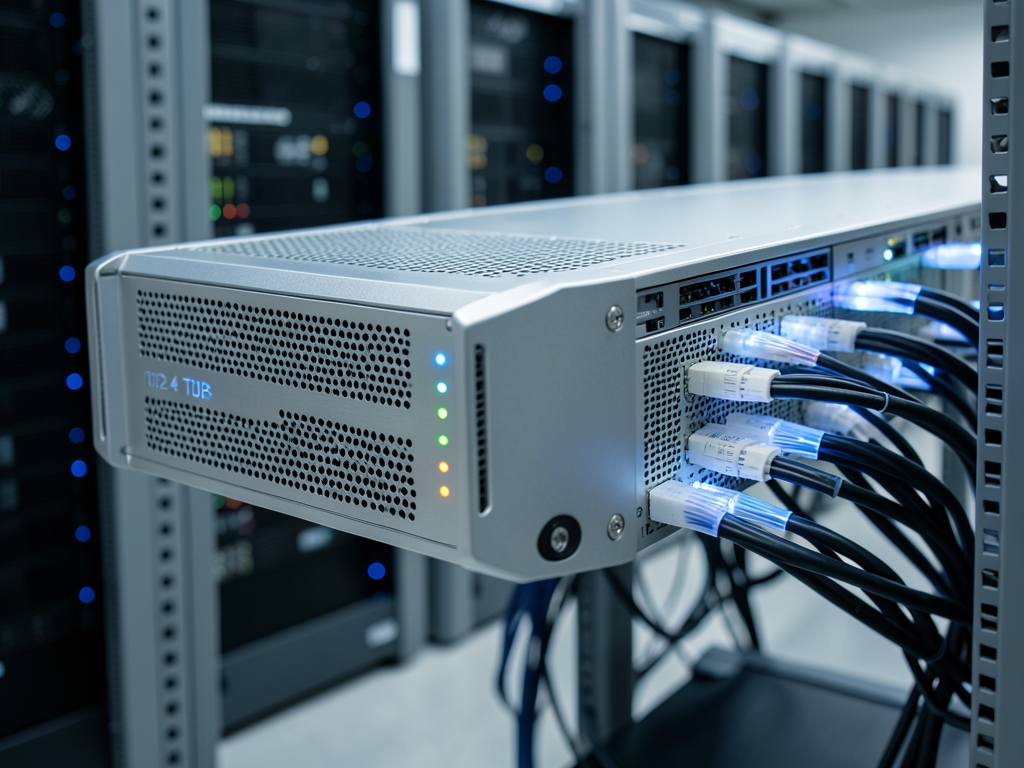
The rapid evolution of artificial intelligence workloads has fundamentally transformed the structural demands placed on modern data centers. As trillion-parameter language models and distributed clusters scale to unprecedented proportions, inter-node communication bottlenecks have emerged as one of the most critical performance inhibitors for enterprise technology infrastructure. Addressing this pressing industry challenge, hardware manufacturers and networking architects have continuously pushed the physical boundaries of semiconductor performance, optical interconnects, and high-speed packet processing engines to ensure that data flows seamlessly across thousands of accelerated computing nodes.
During the opening sessions of the Open Compute Project (OCP) Global Summit, major hardware advancements took center stage, headlined by the introduction of ultra-high-capacity switching silicon designed specifically to handle the immense east-west traffic generated by modern AI training clusters. Among these hardware breakthroughs, the debut of breakthrough networking architectures operating at extreme throughput tiers represents a significant milestone for hyperscale cloud providers and enterprise infrastructure planners navigating the transition toward multi-gigawatt AI deployments.
The Architectural Evolution of Enterprise AI Switching
Traditional data center architectures were historically optimized for north-south traffic patterns, where data flowed primarily between client devices and centralized storage or compute servers. However, the architectural paradigm of generative artificial intelligence relies heavily on distributed training algorithms such as data parallelism and tensor parallelism. These distributed operations require continuous, low-latency synchronization across massive arrays of graphics processing units and specialized AI accelerators.
To prevent processing cores from idling while waiting for gradient updates or model parameter exchanges, underlying network fabrics must deliver exceptional bandwidth density, deterministic latency, and robust congestion management features. The latest generation of switching hardware addresses these demands by integrating advanced PAM4 signaling, high-radix port configurations, and enhanced telemetry features directly into the silicon fabric. By maximizing throughput per rack unit, operators can reduce the physical footprint of their networking infrastructure while simultaneously lowering overall power consumption per gigabit transferred.
Breakthrough Performance Metrics of the Marvell Teralynx T100
At the center of recent industry attention is the Marvell Teralynx T100, which made its official headline appearance at the OCP Global Summit. Delivering an astonishing aggregate switching capacity of 102.4 terabits per second (Tbps), this silicon platform is engineered to support the next generation of hyperscale AI clusters and high-performance computing environments.
The Teralynx T100 architecture is designed to accommodate ultra-dense port configurations, enabling seamless integration with 800G and upcoming 1.6T optical transceiver modules. This high level of integration allows data center operators to build flattened, non-blocking network topologies that minimize the number of switching hops required to traverse the cluster, thereby reducing latency jitter and improving overall computational efficiency for large-scale language model training tasks.
| Feature Specification | Marvell Teralynx T100 Metrics | Enterprise Impact |
|---|---|---|
| Aggregate Throughput | 102.4 Tbps | Eliminates network congestion in massive AI clusters |
| Target Deployment | OCP Data Centers & Hyperscale Cloud | Optimized for high-density rack-scale integrations |
| Transceiver Support | 800G and 1.6T Optical Interfaces | Enables ultra-fast inter-node communication |
| Primary Workload Focus | Distributed LLM Training & GPU Fabrics | Reduces accelerator idle time and training duration |
Integration with OCP Standards and Open Hardware Ecosystems
The Open Compute Project has long served as a collaborative incubator for hyper-efficient data center hardware design, promoting open-source standards that reduce operational friction and vendor lock-in. The introduction of the Teralynx T100 within the OCP ecosystem underscores the growing importance of standardized modular packaging, advanced thermal management solutions, and open network operating system integration.
Modern AI racks demand sophisticated power delivery and cooling mechanisms to support high-density switch trays operating alongside power-hungry accelerator nodes. By aligning with OCP specifications, manufacturers ensure that high-performance silicon can be readily deployed across diverse server architectures, ranging from traditional air-cooled enterprise cages to advanced liquid-cooled hyperscale installations. This compatibility is crucial as facilities prepare for future multi-gigawatt scaling initiatives slated toward the end of the decade.
Addressing Interconnect Bottlenecks and Optics Integration
As switching silicon scales to 102.4 Tbps and beyond, traditional pluggable optical transceivers face mounting challenges regarding thermal dissipation, power efficiency, and signal integrity over front-panel faceplates. Consequently, the industry is increasingly exploring co-packaged optics (CPO) and switch-mounted optics (SMO) architectures to bring optical engines into closer physical proximity with the switching ASIC.
These advanced optical approaches minimize electrical trace lengths on the printed circuit board, significantly reducing signal attenuation and power consumption. Initiatives showcased at the OCP Global Summit highlight a broader industry push toward integrating optical engines directly into AI rack designs, ensuring that network scalability does not outstrip the physical limitations of copper trace technology.
The transition to 102.4 Tbps switching platforms marks a critical turning point for enterprise artificial intelligence, where network infrastructure must evolve in lockstep with accelerator capabilities to prevent multi-billion-dollar computing clusters from stalling on data transit delays.
Broader Market Implications and Investor Sentiment
Despite significant technological leaps in hardware performance, recent market reactions across the semiconductor sector reveal a complex economic landscape. Announcements concerning advanced AI chips, high-speed switches, and expanded infrastructure deployments are frequently met with cautious investor sentiment, as markets weigh massive capital expenditure requirements against immediate monetization timelines for generative AI services.
However, long-term industry projections remain robust. Hyperscale cloud operators, sovereign wealth entities seeking localized infrastructure, and enterprise data center architects continue to prioritize investments in resilient, high-throughput networking fabrics. Technologies like the Teralynx T100 are viewed not merely as incremental upgrades, but as foundational prerequisites for sustaining the exponential growth curve of artificial intelligence capabilities over the coming decade.
Info! Next-generation 102.4 Tbps switches are engineered to support dense 800G and 1.6T optical links, drastically reducing latency for distributed GPU training clusters.
Practical Considerations for Enterprise Network Migration
Migrating to ultra-high-capacity switching fabrics requires careful planning across multiple operational domains. IT and infrastructure leaders must evaluate several key factors before deploying next-generation silicon platforms:
- Thermal and Power Assessment: Ensure that existing data center facilities can support the increased power density and advanced cooling requirements of high-radix AI switches.
- Optical Transceiver Compatibility: Verify that cabling infrastructure and optical modules support high-speed standards such as 800G and emerging 1.6T interfaces without introducing excessive insertion loss.
- Network Operating System Integration: Confirm compatibility with open-source network operating systems and telemetry tools to maintain robust visibility over dynamic traffic flows.
- Cluster Topology Design: Adopt flattened, non-blocking leaf-spine architectures to maximize throughput and minimize latency across distributed accelerator nodes.
By carefully addressing these operational parameters, organizations can successfully integrate high-performance networking silicon into their existing facilities, unlocking the full computational potential of modern artificial intelligence hardware.
What is the primary function of the Marvell Teralynx T100?
The Marvell Teralynx T100 is an advanced high-capacity AI switch silicon designed to deliver 102.4 Tbps of aggregate throughput, specifically engineered to eliminate communication bottlenecks in massive, distributed artificial intelligence and high-performance computing clusters.
Why is a 102.4 Tbps switching capacity necessary for modern AI workloads?
Modern generative AI models require continuous, low-latency synchronization across thousands of GPUs during distributed training. High-capacity switches provide the massive bandwidth density required to prevent processing cores from idling while waiting for data exchanges.
How does the OCP Global Summit relate to new networking hardware?
The Open Compute Project Global Summit serves as a major industry venue where manufacturers debut open-standard hardware, modular rack designs, and high-speed networking architectures tailored for hyperscale data center deployments.
What optical transceiver speeds are supported by next-generation AI switches?
Next-generation high-radix switches are engineered to seamlessly accommodate ultra-dense 800G and upcoming 1.6T optical transceiver modules, enabling exceptionally fast inter-node communication across modern server racks.
Conclusion
The introduction of groundbreaking networking platforms like the Marvell Teralynx T100 at the OCP Global Summit highlights the relentless pace of innovation in enterprise data center technology. As artificial intelligence models continue to scale in complexity and parameter size, the underlying network fabric remains the vital connective tissue that determines overall system efficiency. By embracing high-capacity switching silicon, open hardware standards, and advanced optical integration, the technology industry is successfully laying the robust infrastructure required to power the next era of intelligent computing systems.
