

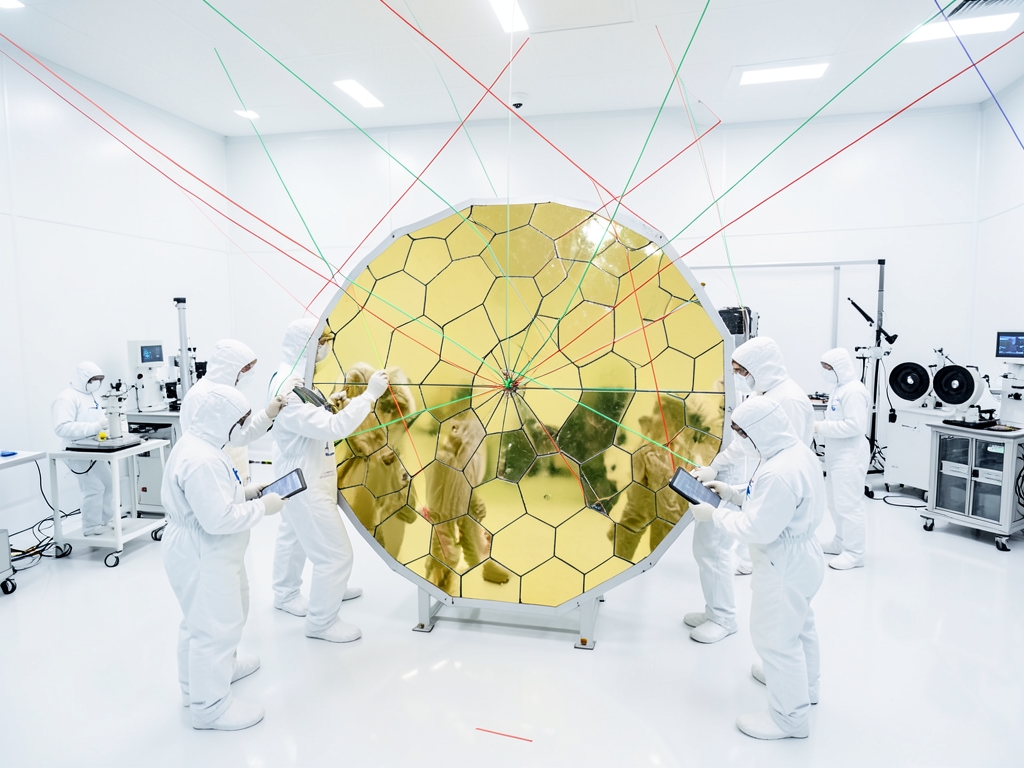
Modern observational astronomy stands on the threshold of a major transformation as space agencies prepare increasingly powerful instruments to peer deeper into the cosmos than ever before. Among these upcoming missions, NASA’s Nancy Grace Roman Space Telescope represents a monumental leap in our capacity to survey the universe. Designed to solve essential mysteries regarding dark energy, exoplanets, and infrared astrophysics, the telescope relies on groundbreaking optical engineering and rigorous pre-launch testing. Recent milestones in the integration and alignment of its optical assembly have brought the mission closer to reality, offering astronomers a powerful tool to map wide swaths of the sky with unprecedented precision.
The primary objective of the Roman Space Telescope is to tackle some of the most profound questions in modern physics and cosmology. While observatories like the Hubble Space Telescope offer incredible deep-field imagery of specific targets, and the James Webb Space Telescope probes the earliest galaxies in high-resolution infrared, the Roman Space Telescope is built for panoramic scale. Its wide-field instrument features a field of view that is approximately one hundred times larger than that of Hubble's infrared instrument. This expansive view allows scientists to capture massive cosmic vistas in a fraction of the time, transforming how researchers study large-scale structures across the universe.
Understanding the Optical Design and Wide-Field Advantage
At the core of the Roman Space Telescope’s capability is its sophisticated optical assembly. The telescope utilizes a 2.4-meter primary mirror, matching the physical size of Hubble's mirror, but engineered with a significantly wider field of view through a specialized optical design. This configuration requires extreme precision in manufacturing and alignment. Even microscopic imperfections in the mirror surface or slight misalignments in the secondary and tertiary mirrors could degrade the quality of wide-field imagery.
Recent testing campaigns conducted by aerospace engineers and optical scientists have focused on verifying the performance of these optical components under simulated space conditions. Because telescopes in orbit experience dramatic thermal shifts and mechanical stresses during launch, optical elements must undergo rigorous thermal-vacuum testing. Engineers subject the mirror assemblies and instrument carriers to extreme temperature fluctuations to ensure that the reflective coatings and structural supports maintain their precise shape without warping.
The ability to image vast expanses of the sky while maintaining sharp, diffraction-limited resolution is the defining characteristic that enables the Roman Space Telescope to conduct statistical surveys of dark energy and distant solar systems.
To achieve this, the telescope relies on a sophisticated metering structure made of advanced composite materials. These materials provide high rigidity while minimizing thermal expansion. As the spacecraft orbits the Sun-Earth Lagrange point 2, maintaining this dimensional stability is critical for keeping the instruments in sharp focus without constant mechanical adjustments.
Probing Dark Energy and Cosmic Acceleration
One of the primary science drivers for the mission is the investigation of dark energy, the mysterious force driving the accelerated expansion of the universe. While astronomers have known about cosmic acceleration for decades, the underlying physics remains elusive. Is dark energy a cosmological constant akin to Einstein’s cosmological constant, or is it a dynamic field of energy that changes over time?
To answer this question, the Roman Space Telescope will employ multiple complementary techniques:
- Wide-Area Galaxy Redshift Surveys: By measuring the positions and distances of millions of galaxies across cosmic time, researchers can map the distribution of matter and track how the expansion rate has evolved.
- Supernova Cosmology: The telescope will discover and monitor thousands of distant Type Ia supernovae, using these standard candles to measure cosmic distances with high precision.
- Weak Gravitational Lensing: By analyzing how the light from distant galaxies is subtly distorted by the gravity of intervening matter, scientists can map the distribution of dark matter throughout the universe.
These combined datasets will provide the statistical power necessary to constrain cosmological models far beyond current observational limits. By surveying billions of galaxies, the mission aims to reduce uncertainties surrounding dark energy equation-of-state parameters.
Exoplanet Discovery and Microlensing Surveys
Beyond cosmology, the Roman Space Telescope is poised to revolutionize the field of exoplanetology. Traditional planet-hunting methods, such as the transit method used by Kepler and TESS, excel at finding planets that orbit close to their host stars. The radial velocity method similarly favors massive planets with short orbital periods. However, discovering cold, distant worlds located far from their host stars requires a different observational approach.
The Roman Space Telescope will achieve this using gravitational microlensing, a technique predicted by Einstein's theory of general relativity. When a foreground star passes in front of a background star from our vantage point, the gravity of the foreground star acts as a magnifying lens, brightening the background star. If the foreground star hosts planets, those planets create distinct secondary perturbations in the magnification light curve.
| Observational Method | Primary Target | Key Advantage |
|---|---|---|
| Wide-Field Imaging | Cosmology and Galaxy Clusters | Massive sky coverage and statistical depth |
| Gravitational Microlensing | Exoplanets in the Galactic Bulge | Detects low-mass planets far from their host stars |
| Coronagraphic Imaging | Direct Exoplanet Imaging | Blocks starlight to image faint planets directly |
Info! Microlensing surveys allow astronomers to detect planets with masses comparable to Earth and Mars, even when they orbit hundreds of millions of kilometers away from their parent stars.
In addition to microlensing, the spacecraft carries a technology demonstration instrument known as a coronagraph. This advanced starlight-blocking device suppresses the glare of nearby stars, enabling astronomers to directly image faint exoplanets and circumstellar disks. Testing the coronagraph's active optical masking systems in laboratory settings is a major milestone for future habitable-planet imaging missions.
Data Architecture and Community Involvement
The volume of data generated by the Roman Space Telescope will be immense, presenting both computational challenges and scientific opportunities. Because the wide-field instrument captures massive images continuously, processing pipelines must handle petabytes of astronomical data. NASA and its international partners have developed sophisticated archiving and analysis frameworks to ensure that researchers around the globe can access and analyze the data efficiently.
Warning! Managing the torrent of incoming data requires automated classification algorithms and machine learning tools, as manual analysis of every detected astronomical transient is impossible at this scale.
Open-science principles are central to the mission architecture. Public access to raw and calibrated data products enables researchers, educators, and citizen scientists to participate in discoveries. From archival searches for rogue planets to serendipitous detections of distant quasars, the broad availability of mission data will foster collaborative research across international academic institutions.
What is the primary scientific goal of the Roman Space Telescope?
The primary scientific goals include investigating the nature of dark energy, conducting wide-field surveys of the universe's structure, and discovering exoplanets using gravitational microlensing techniques.
How does the Roman Space Telescope differ from the Hubble Space Telescope?
While both telescopes feature primary mirrors of the same physical diameter, the Roman Space Telescope is engineered with a wide-field instrument that provides a field of view approximately one hundred times larger than Hubble's infrared instrument.
What is gravitational microlensing and how is it used?
Gravitational microlensing occurs when a foreground star's gravity magnifies light from a background star. If the foreground star has planets, their gravity creates distinct signals in the light curve, allowing astronomers to detect cold, distant planets.
What is the purpose of the onboard coronagraph?
The coronagraph is a technology demonstration instrument designed to block the intense glare of host stars, allowing scientists to directly image faint orbiting exoplanets and circumstellar disks.
As preparations continue toward the scheduled launch window, the successful testing of the telescope's optics marks a vital achievement for modern astrophysics. By combining wide-field mapping capabilities with advanced coronagraphic technology, the mission promises to reshape our understanding of cosmic expansion, galaxy formation, and planetary systems beyond our solar neighborhood. Through careful engineering and rigorous verification, researchers are steadily building the observational infrastructure required for the next era of space exploration.
