

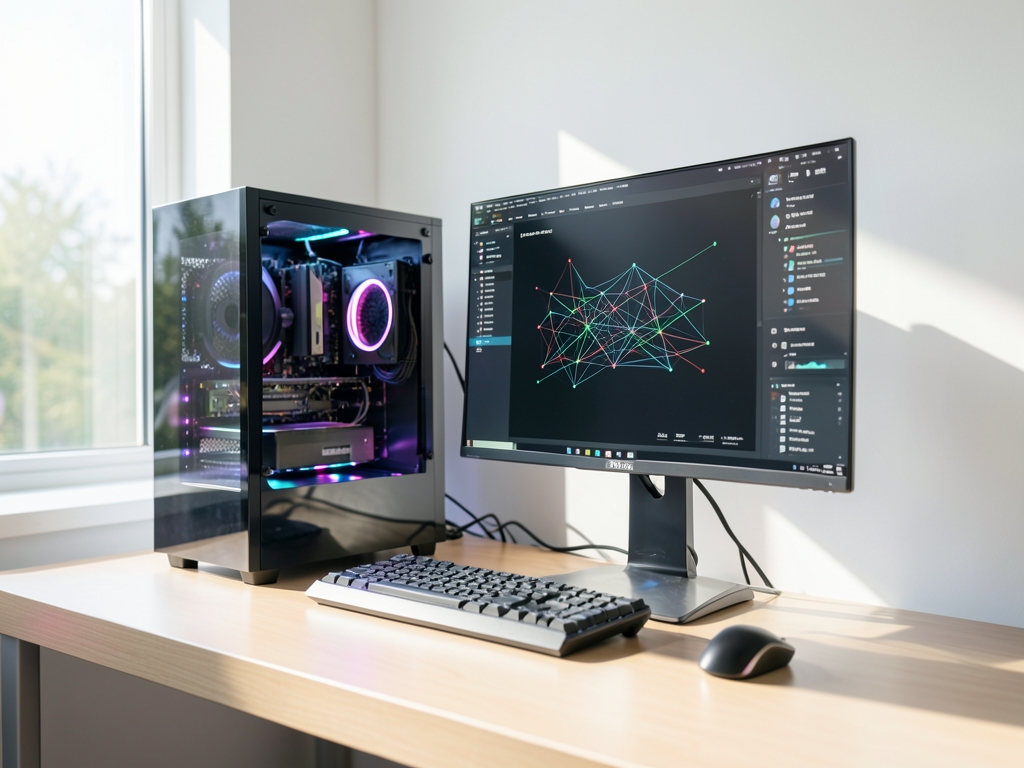
The landscape of personal computing is undergoing a profound structural shift, moving away from entirely cloud-dependent computational models toward robust, localized execution environments. As artificial intelligence models grow increasingly complex, the demand for high-performance on-device hardware has never been more urgent. Engineers, developers, and everyday users require processing capabilities that do not rely on constant internet connectivity or third-party server farms to handle sensitive workflows. Into this dynamic ecosystem steps NVIDIA with its latest initiative, delivering tailored computational solutions designed specifically for consumer and professional Windows operating systems.
This comprehensive architectural evaluation examines the technological foundations, performance metrics, and broader implications of bringing advanced localized machine learning capabilities to standard desktop and laptop environments. By examining how modern graphics processors handle complex neural workloads directly on silicon, we can better understand the trajectory of modern personal computing and what these developments mean for enterprise workflows, software development, and everyday productivity.
The Strategic Pivot Toward Localized Artificial Intelligence Processing
For several years, the mainstream expansion of generative intelligence and deep learning models was characterized by massive cloud-hosted server clusters. While these centralized systems allowed technology companies to scale exceptionally fast, they introduced significant latency, data privacy vulnerabilities, and recurring operational expenses for enterprise clients. Sending proprietary corporate files, sensitive medical imagery, or personal user data across public networks to remote data centers creates inevitable bottlenecks and security concerns.
Localized processing addresses these challenges by executing complex tensor calculations directly on the user's physical machine. Modern operating systems, particularly Windows, have increasingly optimized their core driver architectures to support hardware-accelerated machine learning layers. By integrating specialized processing units directly into consumer hardware, manufacturers ensure that high-throughput tasks like natural language parsing, real-time image generation, and predictive analytics execute with minimal latency and absolute data sovereignty.
Info! Localized AI execution removes dependence on external internet connections, ensuring continuous operation even in offline or bandwidth-restricted environments.
Hardware Foundations: Inside Modern Windows PC Accelerators
At the heart of any high-performance localized computing system lies specialized silicon architecture designed explicitly for parallel floating-point arithmetic. Traditional central processing units handle sequential operations exceptionally well, but deep neural networks require massive matrix multiplication capabilities distributed across hundreds or thousands of independent execution cores.
Graphics processors have long served as the workhorses of parallel computing, but recent generations incorporate dedicated hardware blocks specifically for matrix operations. These specialized cores allow consumer-grade hardware to execute transformer models and computer vision algorithms at speeds that rival enterprise servers of the previous decade. When evaluating how hardware manufacturers optimize these systems for Windows PCs, several core engineering pillars emerge:
- Dedicated Tensor Cores: Specialized hardware blocks engineered to accelerate matrix multiplication operations fundamental to modern deep learning architectures.
- Unified Memory Architecture: High-bandwidth video memory pools that allow large parameter models to reside entirely within fast local memory without bottlenecking through system bus interfaces.
- Low-Precision Quantization Support: Native execution of 8-bit and 4-bit floating-point math, dramatically reducing memory footprint while preserving output accuracy.
- Optimized Driver Stacks: Streamlined software layers that interface directly with operating system machine learning APIs to reduce CPU overhead during inference tasks.
These hardware advancements enable complex applications to run smoothly on standard laptops and desktop towers without requiring liquid cooling or industrial power supplies. The convergence of efficient silicon design and advanced software libraries marks a major milestone in personal computing hardware evolution.
Software Integration and Enterprise Developer Workflows
Hardware capability alone is insufficient without a robust software ecosystem capable of utilizing it effectively. Developers require standardized application programming interfaces and efficient runtime environments to deploy machine learning models across diverse hardware configurations. Recent developments in operating system architecture reflect a concerted effort to unify how applications interact with local graphics accelerators.
When software engineers build applications that leverage local processing, they rely heavily on optimized libraries that translate high-level code into low-level hardware instructions. This translation layer must be exceptionally efficient to prevent unnecessary battery drain on mobile workstations and to maximize frame rates or token generation speeds on desktop systems. Furthermore, enterprise environments demand strict security sandboxing to ensure that local neural models cannot access unauthorized system memory or compromise operating system integrity.
The transition from cloud-centric AI to localized edge computing represents one of the most significant architectural migrations in the history of personal computing, fundamentally redefining user privacy and operational latency.
As software toolchains mature, developers are increasingly able to fine-tune pre-trained models directly on consumer hardware. This capability—often referred to as edge fine-tuning—allows organizations to adapt generic language or vision models to specialized proprietary datasets without exposing sensitive information to external cloud providers. The productivity gains for software development teams operating in secure or regulated industries are substantial.
Performance Benchmarks and Power Efficiency Considerations
Evaluating the practical utility of localized machine learning hardware requires rigorous benchmark analysis across multiple performance vectors. Raw computational throughput, measured in trillion operations per second, provides a theoretical baseline, but real-world user experience depends heavily on thermal management, memory bandwidth utilization, and sustained power draw.
| Metric Vector | Cloud-Based Processing | Local Hardware Execution |
|---|---|---|
| Latency | Variable (Network Dependent) | Near-Instantaneous (Sub-millisecond) |
| Data Privacy | Requires External Transmission | Complete On-Device Containment |
| Offline Capability | None | Full Operational Availability |
| Recurring Costs | API Subscription Fees | Zero Marginal Operating Cost |
| Hardware Requirement | Basic Terminal Access | Dedicated Accelerator Silicon |
Power efficiency remains a critical engineering challenge when deploying heavy workloads on battery-powered Windows laptops. Modern hardware architectures address this by dynamically scaling core frequencies and shutting down idle execution blocks when tensor operations are inactive. This intelligent power management ensures that mobile professionals can execute intensive data analysis tasks in transit without catastrophic battery depletion.
Broader Industry Impact and Future Market Outlook
The widespread adoption of localized computing accelerators is reshaping the competitive dynamics of the global technology sector. Semiconductor manufacturers, independent software vendors, and original equipment manufacturers are forging deeper partnerships to ensure seamless hardware-software co-design. This collaborative approach accelerates innovation cycles, bringing advanced computational capabilities to consumer devices much faster than was previously possible.
For consumers, the benefits manifest as more responsive applications, enhanced creative tools, and robust privacy protections. Tasks that previously required expensive professional workstations can now be performed on mainstream consumer laptops. As manufacturing processes continue to shrink and architectural efficiency improves, the boundary between consumer electronics and high-performance computing will continue to dissolve.
What is localized AI processing on Windows PCs?
Localized AI processing refers to running machine learning models and neural networks directly on a user's physical computer hardware using dedicated graphics processors and tensor cores, rather than sending data to remote cloud servers.
Why is running AI models locally better for data privacy?
When AI workloads execute entirely on your local machine, your personal files, prompts, and proprietary data never leave your device, eliminating the risk of data interception or third-party cloud data harvesting.
Do I need an internet connection to use local AI tools?
No. Once the necessary software models and driver libraries are installed on your Windows PC, local AI processing functions entirely offline without requiring an active internet connection.
What hardware components are most important for local AI performance?
The most critical hardware components are a dedicated graphics processor equipped with specialized tensor cores, high-bandwidth unified video memory, and a modern multi-core central processing unit to manage system instructions.
Conclusion
The integration of advanced localized processing hardware into Windows personal computers marks a decisive turning point in how humanity interacts with computing technology. By combining raw computational power with strict data privacy and zero-latency execution, hardware manufacturers are empowering users and enterprises alike. As software ecosystems continue to evolve around these capable architectures, the future of personal computing will be defined by intelligence that resides not in distant data centers, but right on our desktops and laps.
