

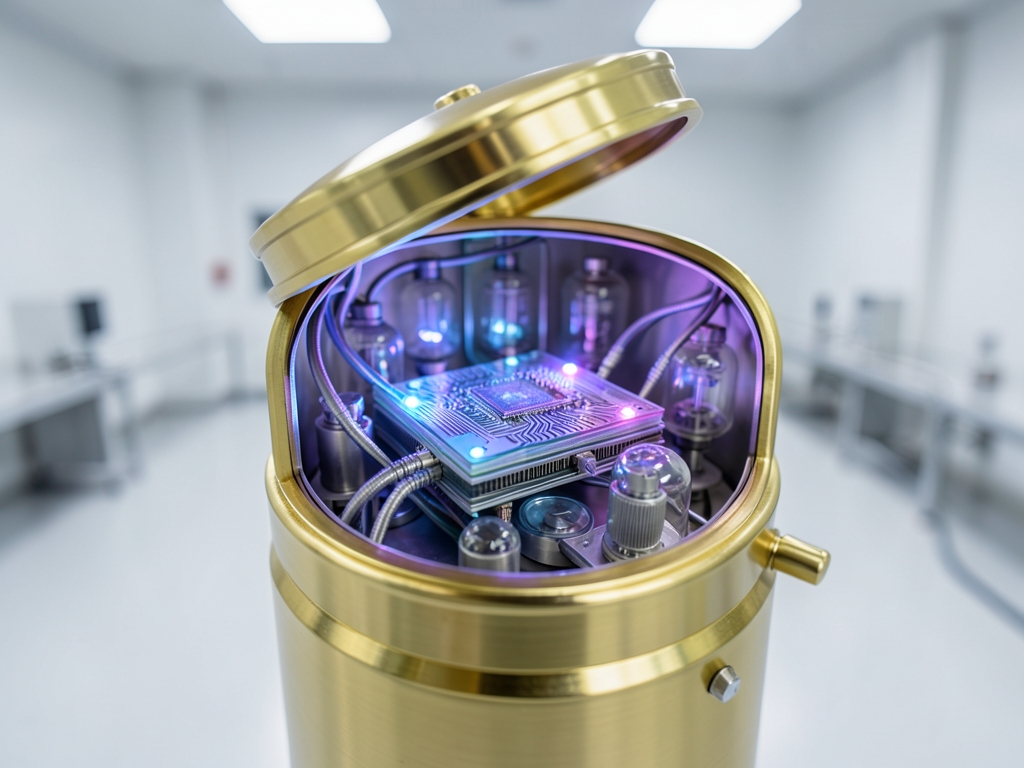
Quantum computing has long promised to revolutionize fields ranging from cryptography and materials science to drug discovery and complex economic modeling. However, the path toward practical, fault-tolerant quantum computers has faced an immense fundamental hurdle: physical qubits are notoriously fragile. Environmental noise, magnetic fluctuations, and thermal interference cause quantum states to collapse or introduce errors far too quickly for long computations to finish reliably. A significant technological breakthrough has recently emerged from collaborative research initiatives involving leading academic institutions and quantum hardware laboratories, demonstrating scalable error-correcting logical qubits that maintain stability over extended computational cycles.
This development addresses the core scaling bottleneck that has constrained the industry for decades. While companies and research labs have steadily increased the raw count of physical qubits on their processors, adding more physical units often compounded noise rather than improving computational power. The new experimental architectures demonstrate that fault-tolerant quantum error correction can be implemented effectively without requiring an unmanageable explosion in physical hardware overhead. In this comprehensive review, we examine the underlying mechanisms of this milestone, the engineering breakthroughs that made it possible, and what this means for the future of enterprise and scientific computing.
Understanding the Physical vs. Logical Qubit Divide
To appreciate the magnitude of the recent announcement, one must understand the structural difference between physical and logical qubits. A physical qubit is the actual hardware implementation—such as a superconducting circuit, a trapped ion, or a neutral atom manipulated by lasers—that holds quantum information. These physical components are analog in nature and highly susceptible to decoherence. Even a microscopic disturbance can flip a qubit from a state of zero to one, or destroy its superposition entirely.
Logical qubits, by contrast, are abstract, error-protected entities built by clustering multiple physical qubits together using sophisticated quantum error-correcting codes. Within this clustered architecture, the system continuously monitors for errors across the constituent physical qubits and corrects them in real time without measuring or destroying the actual quantum data being processed. Until recently, creating stable logical qubits required physical hardware counts that overwhelmed existing cryogenic cooling systems and control electronics. The latest findings mark a turning point by proving that error suppression can scale efficiently as processor sizes increase.
The table below summarizes the key architectural differences between noisy intermediate-scale quantum systems and the newly emerging fault-tolerant logical frameworks.
| Feature | Conventional NISQ Systems | New Fault-Tolerant Logical Systems |
|---|---|---|
| Error Rate | High; degrades rapidly with depth | Suppressed exponentially via redundancy |
| Qubit Type | Raw physical qubits | Entangled clusters forming logical units |
| Correction Method | Post-processing or minimal mitigation | Real-time active syndrome extraction |
| Computational Depth | Limited to shallow circuits | Capable of deep, multi-step algorithms |
Engineering Breakthroughs in Superconducting and Trapped-Ion Architectures
Achieving fault tolerance at scale required simultaneous innovations across multiple engineering disciplines. Researchers tackled the problem from the material science level up to the control software layer. One primary advancement involves the reduction of microscopic dielectric losses on the surface of superconducting chips. By refining the fabrication process of Josephson junctions and utilizing high-purity substrate materials, engineers successfully doubled the coherence times of individual physical components.
Info! Coherence time refers to the duration a qubit can maintain its quantum state before environmental interference causes information loss.
Furthermore, improvements in mid-circuit measurement techniques allow researchers to detect errors within the quantum register while the calculation is actively running. In older hardware designs, measuring a qubit's state terminated its quantum properties immediately. The new approach employs auxiliary measurement qubits that interact with data qubits to extract error syndrome information without collapsing the primary computational superposition. This non-destructive readout capability is essential for running error correction cycles continuously.
Control electronics have also undergone a radical transformation. Traditional setups relied on room-temperature rack-mounted pulse generators connected to the cryogenic chamber via massive coaxial cable arrays. As processor scales approached thousands of physical components, thermal load and signal degradation became prohibitive. Modern systems integrate cryogenic CMOS control chips operating at near-absolute zero directly alongside the quantum processor, drastically minimizing latency and signal noise.
Implications for Cryptography, Simulation, and Enterprise Technology
The transition from noisy quantum prototypes to fault-tolerant logical processing fundamentally alters the timeline for commercial viability. Industries that rely heavily on complex molecular simulation, optimization, and cryptographic security must begin preparing for a post-quantum cryptographic landscape much sooner than previously anticipated.
In the pharmaceutical sector, molecular simulation is currently constrained by the inability of classical supercomputers to accurately model electron correlation in large biomolecules. Fault-tolerant quantum computers with stable logical qubits will enable exact quantum-mechanical modeling of chemical reactions, drastically accelerating drug discovery pipelines. Similarly, logistics and supply chain enterprises can leverage quantum annealing and optimization algorithms to solve NP-hard routing problems in real time, saving billions in operational inefficiencies.
The ability to maintain stable logical qubits over extended algorithmic depths represents the single most important milestone on the roadmap to utility-scale quantum computing.
However, cybersecurity represents the most immediate area of strategic focus. While widespread deployment of cryptographically relevant quantum computers remains years away, government agencies and financial institutions are already migrating toward post-quantum encryption standards to protect sensitive data against retrospective decryption attacks.
Practical Steps for Organizations Preparing for Quantum Readiness
Organizations across finance, defense, and enterprise software cannot afford to wait until commercial fault-tolerant systems are universally available. Preparing technical infrastructure for the quantum era requires a structured, multi-phase roadmap.
- Conduct a comprehensive inventory of all cryptographic assets and data storage protocols currently deployed within your enterprise network.
- Identify legacy encryption algorithms—such as RSA and ECC—that are vulnerable to Shor's algorithm once scalable quantum hardware matures.
- Transition critical infrastructure toward NIST-approved post-quantum cryptography standards and cryptographic agility frameworks.
- Establish internal R&D partnerships or cloud-based quantum service access to test algorithmic workflows on early-stage hybrid systems.
Warning! Delaying cryptographic migration until quantum hardware reaches full commercial availability creates severe compliance and data exposure risks.
Future Outlook and Global Research Landscape
The global race to build fault-tolerant quantum computers continues to accelerate, with national laboratories and private technology enterprises investing heavily in diverse architectural approaches. While superconducting circuits currently lead in gate speed and integration density, trapped-ion and neutral-atom platforms offer superior qubit connectivity and exceptionally long coherence times. The ultimate winning architecture may well combine the strengths of multiple modalities into heterogeneous hybrid networks.
As research teams continue to refine error-correcting codes—such as surface codes and color codes—the threshold of physical qubits required per stable logical qubit is steadily decreasing. This algorithmic efficiency improvement means that practical utility may arrive faster than projected by older scaling models.
What is the main difference between physical and logical qubits?
Physical qubits are the actual hardware components that store quantum information but are extremely sensitive to environmental noise. Logical qubits are error-protected abstract units created by grouping multiple physical qubits together and applying active error correction algorithms to maintain stability.
Why is quantum error correction necessary for commercial applications?
Without error correction, environmental interference causes quantum states to decohere rapidly, leading to computational errors that accumulate and ruin long calculations. Error correction allows systems to detect and fix these errors in real time without destroying the underlying data.
How does mid-circuit measurement improve quantum processors?
Mid-circuit measurement allows engineers to check for errors and extract syndrome data while a calculation is actively running, without collapsing the primary quantum superposition required for the computation.
What industries will be impacted most by fault-tolerant quantum computing?
The primary industries affected include cybersecurity, pharmaceuticals and molecular chemistry, logistics optimization, financial modeling, and advanced materials science, all of which rely on complex simulations beyond classical computing limits.
The recent achievement of scalable error-correcting logical qubits marks a defining moment in the evolution of modern technology. By successfully overcoming the barriers of physical decoherence and hardware noise, researchers have opened the door to a new era of stable, high-depth quantum computations. As engineering techniques continue to mature, the transition from experimental physics laboratories to practical enterprise utility is moving closer to reality, promising to reshape the boundaries of human problem-solving across every major scientific and industrial domain.
