

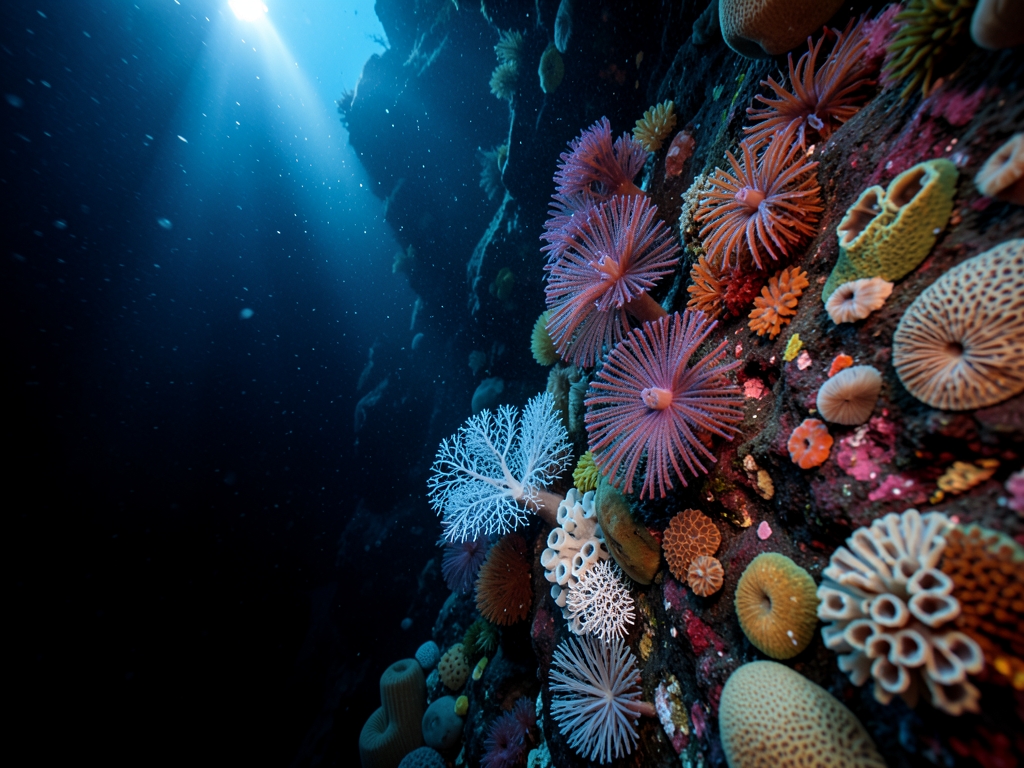
Oceans cover over seventy percent of the Earth's surface, yet the vast majority of the marine realm remains entirely unmapped and poorly understood. Beneath the sunlit surface waves lies a hidden world characterized by immense pressure, absolute darkness, and freezing temperatures. Among the most fascinating and ecologically significant discoveries in recent oceanographic research are deep-sea coral ecosystems flourishing within steep submarine canyons. Far from being barren underwater deserts, these deep-water habitats host extraordinary biodiversity, rivaling their shallow-water tropical counterparts in ecological complexity and structural magnificence.
Recent marine expeditions utilizing advanced autonomous underwater vehicles, remotely operated submersibles, and high-resolution multibeam sonar mapping have transformed our understanding of how deep-sea corals survive and build massive reefs miles beneath the ocean surface. Scientists from international marine research institutes have recently published comprehensive mapping data detailing previously unknown coral structures lining the walls of deep continental slope canyons. These findings shed light on crucial oceanographic processes, nutrient transport mechanisms, and the delicate balance of benthic marine life that depends entirely on these fragile underwater forests.
The Unique Environment of Submarine Canyons
Submarine canyons are massive topographical trenches carved into continental shelves and slopes, often rivaling or exceeding the scale of grand terrestrial canyons. These dramatic underwater features act as primary conduits for sediment, organic matter, and mineral-rich water flowing from shallow coastal zones down into the deep abyssal plains. The extreme topography of submarine canyons creates dynamic local oceanography, generating powerful internal waves, accelerated tidal currents, and intense upwelling zones that draw nutrient-laden water upward from the deep ocean.
This constant hydrodynamic activity provides an ideal habitat for suspension-feeding organisms, particularly deep-sea stony corals, soft corals, black corals, and gorgonians. Unlike shallow-water corals that rely on photosynthetic algae called zooxanthellae for energy, deep-water coral species are strictly heterotrophic. They depend entirely on capturing passing organic particles, marine snow, microscopic zooplankton, and dissolved organic carbon swept along by canyon currents. The unique flow dynamics within submarine canyons ensure a steady, reliable food supply, allowing massive coral colonies to thrive in perpetual darkness at depths ranging from two hundred meters to over three thousand meters below sea level.
Structural Complexity and Biodiversity Hotspots
The calcium carbonate skeletons and dense branching frameworks built by stony corals over hundreds or even thousands of years create highly complex three-dimensional habitats. This intricate structural architecture provides essential shelter, breeding grounds, and nursery areas for an astonishing array of marine species, including commercially important fish populations, deep-water sharks, crustaceans, mollusks, and rare echinoderms.
Info! Recent submersible surveys have identified dozens of previously undocumented invertebrate species inhabiting deep canyon walls, highlighting how much of the ocean's biodiversity remains uncataloged.
Smaller organisms such as brittle stars, polychaete worms, and feather stars find refuge among the coral branches, safe from fast-swimming pelagic predators. Larger predatory fish, including various species of rockfish, grenadiers, and slickheads, patrol these structural oases in search of prey. The loss or degradation of these deep-sea coral ecosystems would trigger cascading ecological collapse throughout the regional food web, drastically impacting deep-water marine biodiversity and altering vulnerable benthic habitats.
Advanced Mapping Technologies Revolutionizing Marine Discovery
For centuries, the deep ocean remained virtually inaccessible to direct scientific observation. Early oceanographers relied on rudimentary weighted sounding lines that provided only scattered depth measurements, leaving massive gaps in bathymetric knowledge. Today, a combination of state-of-the-art acoustic instruments and robotic exploration platforms has revolutionized marine science, enabling researchers to map submarine canyons with unprecedented centimeter-level accuracy.
Multibeam echosounders mounted on modern research vessels emit fan-shaped arrays of acoustic pulses toward the seafloor, measuring the exact return travel time to construct detailed three-dimensional bathymetric maps. When combined with backscatter data, these acoustic systems allow marine geologists and biologists to distinguish between soft sediment, bare rock, and dense biological thickets before deploying physical sampling gear or robotic submersibles.
| Technology | Primary Function | Operating Depth Range | Key Scientific Contribution |
|---|---|---|---|
| Multibeam Sonar | Seafloor Bathymetric Mapping | Surface to Full Ocean Depth | Identifies canyon topography and hard substrate zones |
| Autonomous Underwater Vehicles (AUVs) | Grid-Based Photographic Surveys | 50 meters to 6,000 meters | Captures high-resolution imagery without tether constraints |
| Remotely Operated Vehicles (ROVs) | Direct Observation and Sampling | Surface to 6,000+ meters | Enables precise biological sampling and HD video recording |
| Laser Scanning Systems | Structural Measurement | Varies by Submersible Class | Calculates exact coral colony volume and growth rates |
Once high-priority canyon sites are identified via sonar mapping, scientists deploy remotely operated vehicles equipped with high-definition stereoscopic cameras, robotic manipulator arms, and precision suction samplers. These advanced robotic platforms allow researchers to examine delicate coral structures up close, measure water chemistry parameters in real time, and collect small tissue samples for genetic analysis without causing catastrophic damage to the surrounding reef ecosystem.
Threats Facing Deep-Sea Coral Ecosystems
Despite their remote locations deep beneath the surface, deep-sea coral ecosystems face mounting anthropogenic pressures and environmental threats. Because many deep-water coral species grow at exceedingly slow rates—sometimes adding less than a millimeter of skeletal growth per year—damage inflicted upon these habitats can take centuries to recover naturally.
Bottom trawling remains one of the most immediate and destructive physical threats to deep-sea benthic environments. Heavy commercial fishing nets equipped with steel weighted doors dragged across the seafloor can pulverize fragile coral thickets in seconds, reducing centuries-old structural habitats into rubble fields. While international regulatory bodies and regional fisheries management organizations have established protected areas in various high-seas submarine canyons, enforcement and monitoring across vast ocean expanses remain significant logistical challenges.
Warning! Climate change poses an escalating systemic threat to deep-sea corals through ocean acidification, warming bottom temperatures, and expanding oxygen minimum zones.
As anthropogenic carbon dioxide emissions continue to be absorbed by global ocean waters, the chemical composition of seawater shifts, lowering carbonate ion saturation states. This chemical alteration makes it increasingly difficult for calcifying organisms to build and maintain their calcium carbonate skeletal structures. Furthermore, shifting deep-water circulation patterns and expanding hypoxic zones can suffocate sessile marine life, threatening the long-term survival of entire deep-sea biological communities.
Conservation Strategies and Future Research Directions
Protecting vulnerable deep-sea coral ecosystems requires coordinated international cooperation, robust legislative frameworks, and continued scientific exploration. Marine conservationists advocate for the establishment of expanded marine protected areas specifically designated around submarine canyon systems, prohibiting destructive fishing practices such as bottom trawling and deep-sea mineral exploration within ecologically sensitive boundaries.
Ongoing research initiatives focus on tracking larval dispersal patterns, studying the genetic connectivity between isolated coral populations, and monitoring long-term environmental shifts using stationary benthic observatories. By understanding how deep-sea corals adapt to changing environmental conditions, scientists can better predict future ecological shifts and formulate effective conservation policies to safeguard these magnificent underwater ecosystems for future generations.
What are deep-sea corals and how do they survive without sunlight?
Deep-sea corals are specialized marine invertebrates that thrive in cold, dark waters miles beneath the ocean surface. Unlike shallow-water corals that rely on photosynthetic algae, deep-water species are heterotrophic, surviving by capturing passing organic particles, marine snow, and zooplankton transported by powerful canyon currents.
Why are submarine canyons important for marine biodiversity?
Submarine canyons act as nutrient conduits and dynamic hydrodynamic zones. Their steep topography accelerates currents and drives upwelling, creating ideal conditions for massive coral growth. This complex physical structure provides vital shelter, breeding grounds, and nurseries for numerous fish and invertebrate species.
What technology do scientists use to map and study deep-sea canyons?
Researchers utilize advanced multibeam echosounders for high-resolution bathymetric mapping, autonomous underwater vehicles for grid-based photographic surveys, and remotely operated vehicles equipped with robotic arms and high-definition cameras for direct observation and sampling.
What are the primary environmental threats facing deep-sea coral ecosystems?
The most significant threats include physical destruction from commercial bottom trawling, ocean acidification that weakens coral skeletal structures, rising deep-water temperatures, and expanding oceanic oxygen minimum zones that stress benthic marine life.
The recent discoveries stemming from advanced submarine canyon mapping underscore the urgent need for comprehensive global ocean stewardship. As marine scientists continue to unveil the hidden complexities of deep-sea coral ecosystems, protecting these fragile biological oases remains paramount to preserving the overall health and resilience of our planet's marine environment.
