

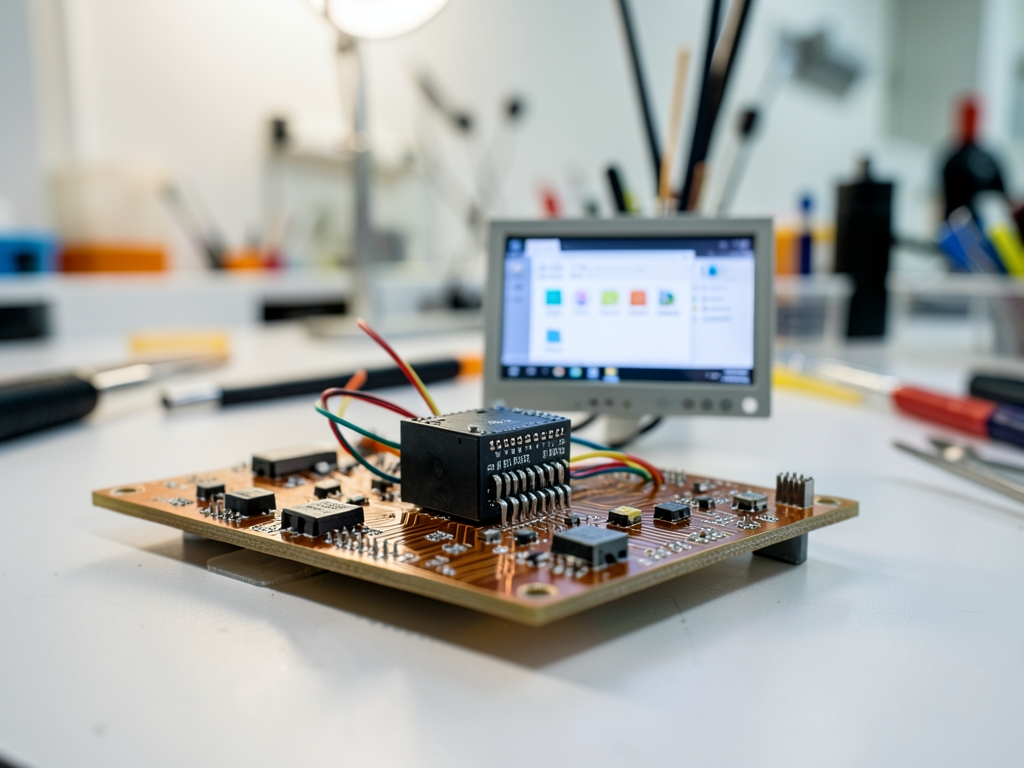
The traditional boundary separating resource-constrained microcontrollers from fully fledged desktop computing environments has long been defined by strict hardware limitations. Microcontrollers—compact integrated circuits designed to govern specific operations in embedded systems—typically operate with mere kilobytes of RAM and modest clock speeds. These tiny processors excel at executing dedicated firmware loops for appliances, sensors, and automotive sub-systems, but they have never been expected to host a recognizable desktop user interface. However, recent developments in embedded systems engineering are challenging these long-held architectural boundaries, opening up new possibilities for edge computing.
The release and demonstration of specialized software solutions tailored for ultra-low-power silicon have captured the attention of systems architects and hardware hobbyists alike. Among these innovations, the emergence of lightweight operating systems capable of managing graphical windowing environments on minuscule silicon footprints marks a fascinating departure from standard microcontroller usage. Engineers and developers are increasingly looking for ways to harness distributed processing power directly at the edge, reducing latency and reliance on cloud infrastructure by running advanced software stacks on local, inexpensive hardware.
Understanding Microcontroller Constraints and Embedded Architecture
To appreciate the technical significance of bringing desktop-style computing to microcontrollers, one must first examine the hardware architecture of typical embedded chips. Unlike conventional personal computers powered by multi-gigahertz multi-core processors and gigabytes of fast dynamic RAM, standard microcontrollers rely on static RAM measured in tens or hundreds of kilobytes. Flash memory for program storage is similarly constrained, usually occupying a few megabytes at most. These constraints require developers to write highly optimized, bare-metal C or C++ code, bypassing traditional operating system abstractions to ensure deterministic real-time performance.
For decades, operating systems designed for microcontrollers—often referred to as Real-Time Operating Systems or RTOS—have prioritized lightweight task scheduling, minimal interrupt latency, and low power consumption over rich user interfaces. An RTOS does not render windows, handle mouse pointers, or manage complex file systems in the way a modern desktop OS does. Instead, it coordinates background tasks, manages peripheral communications via SPI, I2C, or UART protocols, and ensures that critical safety routines execute without delay. Introducing desktop computing paradigms into this domain requires a radical rethink of memory management, graphical rendering pipelines, and driver abstraction layers.
How Sylphide OS Bridges the Gap Between Desktop Software and Tiny Silicon
The introduction of specialized software environments capable of rendering desktop interfaces on microcontrollers represents a notable technical achievement in embedded systems design. By implementing highly optimized virtual machine layers, streamlined display servers, and compressed asset management, developers can now deploy graphical desktop interfaces onto hardware that traditionally ran simple blinking-LED scripts or sensor-reading loops. This capability transforms simple evaluation boards into capable, standalone computing nodes.
At the core of this transformation is extreme software minimalism. Memory management units on microcontrollers are often rudimentary or entirely absent, meaning the operating system must handle memory allocation with absolute precision to prevent segmentation faults and buffer overflows. By utilizing innovative memory-mapping techniques and streaming assets directly from external flash storage, these environments bypass internal RAM limitations. The resulting interface allows users to interact with basic window managers, text editors, and system monitors directly on tiny screens connected to low-cost microcontroller development boards.
Technical Specifications and Hardware Requirements
Running a desktop-capable operating system on a microcontroller demands careful selection of peripheral hardware and underlying silicon. While traditional 8-bit microcontrollers lack the processing throughput for such tasks, modern 32-bit ARM Cortex-M or RISC-V microcontrollers running at clock speeds between 100 MHz and several hundred megahertz provide a viable foundation. These chips often feature integrated hardware floating-point units and sufficient GPIO bandwidth to drive small TFT or OLED displays.
Info! Successful implementation typically requires external PSRAM or hyper-RAM chips to supplement the limited internal memory of the microcontroller, providing the workspace needed for frame buffers and application runtimes.
Below is an overview comparing traditional microcontroller operating environments with advanced desktop-capable embedded software stacks:
| Feature Category | Traditional RTOS Environment | Desktop-Capable Embedded OS |
|---|---|---|
| Primary Silicon Target | 8-bit to 32-bit Microcontrollers | High-Performance 32-bit ARM / RISC-V |
| RAM Utilization | 2 KB to 64 KB | 256 KB to 8 MB (with external PSRAM) |
| User Interface | Headless or simple character LCD | Graphical window manager, mouse support |
| Storage Requirements | Kilobytes of internal Flash | Megabytes of Flash / MicroSD storage |
| Primary Use Case | Real-time sensor polling, motor control | Standalone edge computing, portable terminals |
Practical Applications for Edge Computing and IoT
The ability to run desktop-grade software abstractions on microcontrollers is not merely an engineering novelty; it carries practical implications for the Internet of Things (IoT) and industrial automation. In many field deployments, technicians require local diagnostic interfaces without hauling bulky laptops or relying on unstable wireless connections to remote servers. A microcontroller-based terminal running a lightweight graphical interface provides an immediate, low-power diagnostic console right at the machine level.
Furthermore, educational institutions and embedded systems hobbyists stand to benefit immensely from accessible computing platforms. Learning operating system concepts, graphical user interface design, and systems programming becomes significantly more engaging when students can deploy a functioning desktop environment onto a ten-dollar development board. This democratization of hardware capability encourages experimentation and lowers the barrier to entry for advanced computer science concepts.
Potential Challenges and Limitations
Despite the impressive ingenuity behind bringing desktop computing to microcontrollers, significant engineering challenges remain. Power consumption, thermal dissipation in enclosed spaces, and sluggish frame rates can impact user experience. Because microcontrollers lack the dedicated graphics processing units found in modern PCs, rendering window animations and handling input events consumes a substantial portion of the available CPU cycles, leaving fewer resources for actual background computations or sensor processing tasks.
Warning! Developers must carefully balance visual fidelity with system stability; overloading a constrained microcontroller with complex graphical elements can lead to system freezes and watchdog resets in mission-critical applications.
Security is another critical consideration. Embedded devices deployed in field environments are often vulnerable to physical tampering and side-channel attacks. When microcontrollers begin running more complex software stacks with dynamic file systems and external memory buses, the attack surface expands. Ensuring robust cryptographic boot verification and secure firmware update mechanisms becomes paramount as these systems take on more versatile computational roles.
Future Outlook for Microcontroller Software Architecture
The ongoing convergence of desktop-style usability and microcontroller efficiency highlights the rapid pace of semiconductor and software innovation. As silicon manufacturers continue to pack more processing power, integrated memory, and specialized accelerators into smaller, energy-efficient packages, the distinction between microcontrollers and microprocessors will continue to blur. Software projects that push the limits of what low-power silicon can achieve serve as valuable testbeds for the future of ubiquitous computing.
Ultimately, these developments point toward a future where computing power is decentralized, resilient, and embedded seamlessly into everyday physical objects. Whether utilized in industrial monitoring, educational kits, or experimental edge devices, the ability to run sophisticated software on modest hardware expands the toolkit available to modern engineers and developers worldwide.
Can any standard microcontroller run a desktop operating system?
No, standard 8-bit or low-end 16-bit microcontrollers lack the memory and processing throughput required. Running desktop-style environments typically demands high-performance 32-bit ARM Cortex-M or RISC-V processors paired with external RAM.
Do these embedded operating systems replace traditional RTOS?
They do not replace real-time operating systems in mission-critical, hard real-time applications where deterministic response times are mandatory. Instead, they target standalone or auxiliary edge-computing use cases.
What kind of display hardware is needed for these setups?
Most implementations utilize small SPI or parallel interface TFT LCDs, touchscreens, or OLED panels capable of connecting directly to the GPIO pins or display controllers of the microcontroller development board.
Why is external RAM often required for these projects?
Internal SRAM on microcontrollers is usually restricted to a few hundred kilobytes at most, which is insufficient for storing graphical frame buffers, window states, and application memory simultaneously.
As embedded systems continue to evolve, staying informed about breakthroughs in low-power architecture and software optimization remains essential for developers and technology enthusiasts navigating the shifting landscape of modern hardware engineering.
