

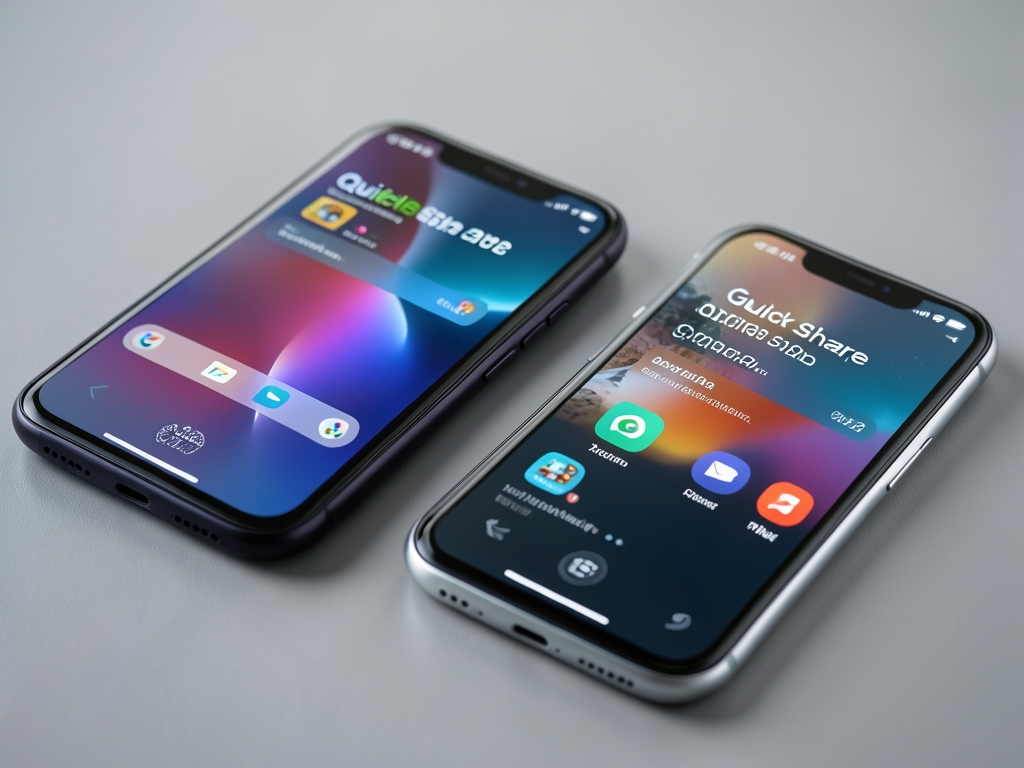
The landscape of mobile file sharing is undergoing a profound transformation. For years, transferring files between disparate operating systems has involved clunky workarounds, third-party messaging apps, or cloud storage links that require tedious uploading and downloading. While ecosystems like Apple’s AirDrop have perfected local device-to-device sharing within a single walled garden, bridging the gap between Android and iOS has historically remained an exercise in frustration. However, recent announcements from industry developers and mobile standard bodies indicate that this friction point is finally being addressed at a foundational level. The upcoming introduction of the Google Quick Share Software Development Kit, slated for release in 2027, promises to unify local file sharing across major mobile platforms, fundamentally altering how developers integrate seamless transfer capabilities into everyday applications.
To understand the significance of this development, it helps to examine how local file sharing has evolved across mobile ecosystems. Historically, Android users relied on proprietary manufacturer solutions before Google consolidated the ecosystem around Quick Share, merging the best elements of Android Beam, Nearby Share, and Samsung’s Quick Share protocol. Meanwhile, Apple users enjoyed the effortless speed of AirDrop, which leverages Wi-Fi Direct and Bluetooth to transmit large files locally without consuming cellular data or requiring an active internet connection. Yet, third-party applications running on these devices operated in isolation. If a user wanted to send a document generated inside a productivity app on an iPhone to a nearby Android tablet, they were forced to export the file to cloud storage or rely on Bluetooth pairing quirks that often failed. The 2027 Quick Share SDK aims to eliminate these artificial boundaries by providing developers with standardized APIs that function natively across both mobile operating systems.
The Technical Architecture Behind the 2027 SDK Rollout
Implementing a unified file-sharing protocol across Android and iOS requires navigating vastly different security models, background processing limitations, and hardware abstraction layers. Apple maintains strict sandboxing rules that restrict how apps interact with raw networking sockets and peripheral discovery protocols. Conversely, Android offers more flexible, albeit tightly managed, permissions for nearby device scanning. The new Google Quick Share SDK has been engineered to bridge these architectural gaps by abstracting the underlying transport mechanisms—such as Bluetooth Low Energy for discovery and high-speed Wi-Fi Direct for data transmission—into a single, clean programming interface.
Software engineers building mobile applications will no longer need to write custom networking stacks or implement proprietary server relays just to allow users to share content between devices sitting on the same desk. Instead, by integrating the SDK, applications will be able to invoke a standardized sharing sheet that natively detects nearby compatible devices, regardless of whether the recipient is holding an Android handset or an iPhone. This abstraction layer handles connection handshakes, encryption key exchanges, and bandwidth optimization automatically, significantly reducing development overhead while ensuring robust security standards during transfer sessions.
The upcoming SDK launch represents a pivotal shift from closed ecosystem sharing to open, protocol-driven interoperability, allowing third-party applications to bypass traditional cloud bottlenecks entirely.
Info! The deployment timeline targets full availability for developers by 2027, giving software teams ample time to test integration frameworks before widespread consumer rollout.
Impact on Third-Party Applications and Developer Workflows
The decision to distribute Quick Share as an SDK rather than keeping it strictly tied to native operating system utilities opens up exciting possibilities for app developers. Productivity suites, photo editing tools, document scanners, and media creation applications stand to benefit the most from this shift. Imagine editing a high-resolution vector graphic inside a mobile design app on an iPad and wanting to transfer the raw project file instantly to a nearby Android workstation for rendering. With the new SDK embedded directly into the application code, the transfer can happen locally, securely, and within seconds, without ever touching external servers.
| Feature Aspect | Legacy Transfer Methods | Upcoming Quick Share SDK (2027) |
|---|---|---|
| Platform Support | Fragmented (OS-specific or app-locked) | Unified across Android and iOS |
| Network Requirement | Often requires cloud upload/download | Purely local Wi-Fi Direct and Bluetooth |
| Developer Integration | Custom networking stacks required | Standardized, easy-to-implement APIs |
| Transfer Speed | Limited by internet bandwidth | Maximized by local hardware speeds |
For independent developers and small studios, building reliable peer-to-peer networking has always been cost-prohibitive and technically daunting. By standardizing these capabilities, Google lowers the barrier to entry for advanced local connectivity. Users will increasingly expect their favorite apps to support direct, cross-device sharing as a baseline feature, shifting competitive advantage toward software platforms that embrace frictionless interoperability rather than locking users into proprietary sharing silos.
Security, Privacy, and Local Encryption Protocols
Whenever direct device-to-device communication is expanded across platforms, security and user privacy emerge as paramount concerns. Transmitting data locally avoids the privacy pitfalls of uploading sensitive documents to third-party cloud servers, but it introduces new vectors for unauthorized access if not properly secured. The architecture of the upcoming Quick Share SDK incorporates end-to-end encryption protocols designed to ensure that data packets transferred between devices remain entirely unreadable to intermediate sniffers or unauthorized nearby handsets.
Furthermore, user consent mechanisms will remain strictly enforced. Devices will operate in visibility modes that require explicit user approval before establishing a connection handshake. Just as current sharing utilities prompt users with a cryptographic confirmation pin or a manual accept prompt, applications utilizing the new SDK will be bound by operating system permission prompts. This guarantees that malicious applications cannot silently harvest data from nearby phones without the explicit awareness and consent of the device owner.
- Developer integrates the official Quick Share SDK into their mobile application codebase.
- The app invokes the standardized sharing interface when a user initiates a local transfer.
- The SDK handles secure discovery via Bluetooth Low Energy and establishes an encrypted Wi-Fi Direct link.
- The recipient approves the transfer prompt on their device, completing the high-speed file transfer locally.
Broader Implications for the Mobile Hardware and Software Market
The introduction of a cross-platform sharing SDK highlights a broader industry trend toward pragmatic cooperation between dominant technology giants. While hardware competition in the smartphone sector remains fierce—with brands constantly vying for supremacy in camera technology, display engineering, and processing power—software infrastructure is increasingly moving toward open standards. Regulatory pressures, consumer demand, and the rising complexity of multi-device households have made walled gardens harder to justify for everyday productivity.
Consumers who routinely mix device brands—such as owning a Windows PC, an Android phone, and an iPad—will find immense value in applications that respect their hardware choices. As developers adopt the new framework throughout 2027, the friction associated with moving files across ecosystem boundaries will gradually dissolve. This evolution ultimately empowers users, shifting the focus of mobile apps away from where files are stored and toward what users can accomplish with them.
What is the Google Quick Share SDK?
The Google Quick Share SDK is a developer toolkit announced for 2027 that allows third-party app developers to integrate native, high-speed, cross-platform file sharing directly into their mobile applications for both Android and iOS.
When will the Quick Share SDK be available for developers?
Current industry reports and developer roadmaps point toward a full rollout and availability window arriving in 2027.
Will this SDK allow file transfers between Android and iOS?
Yes, the primary objective of the SDK is to bridge operating system divides, enabling seamless local file transfers between Android devices and iPhones or iPads within compatible applications.
Are transfers made using the SDK secure?
Yes, transfers utilize local encrypted protocols such as Wi-Fi Direct and Bluetooth Low Energy, combined with mandatory user confirmation prompts to ensure complete privacy and security.
As the mobile ecosystem marches toward 2027, the impending release of the Quick Share SDK stands out as a milestone for software interoperability. By removing technical barriers between rival operating systems, developers can build more cohesive and efficient applications. Whether for professional workflows or casual media sharing, the future of mobile connectivity is becoming faster, safer, and remarkably more unified.
Sources and Further Reading
- Google Quick Share SDK Coming to Android and iOS Apps in 2027 - Smartprix — Smartprix (published 2026-11-03 09:15)
- Quick Share Is Coming to Android and iOS Apps With a 2027 SDK - AndroidPure — AndroidPure (published 2026-11-03 03:28)
- Google's Quick Share could be coming to the apps you already use - Android Police — Android Police (published 2026-11-03 01:35)
