

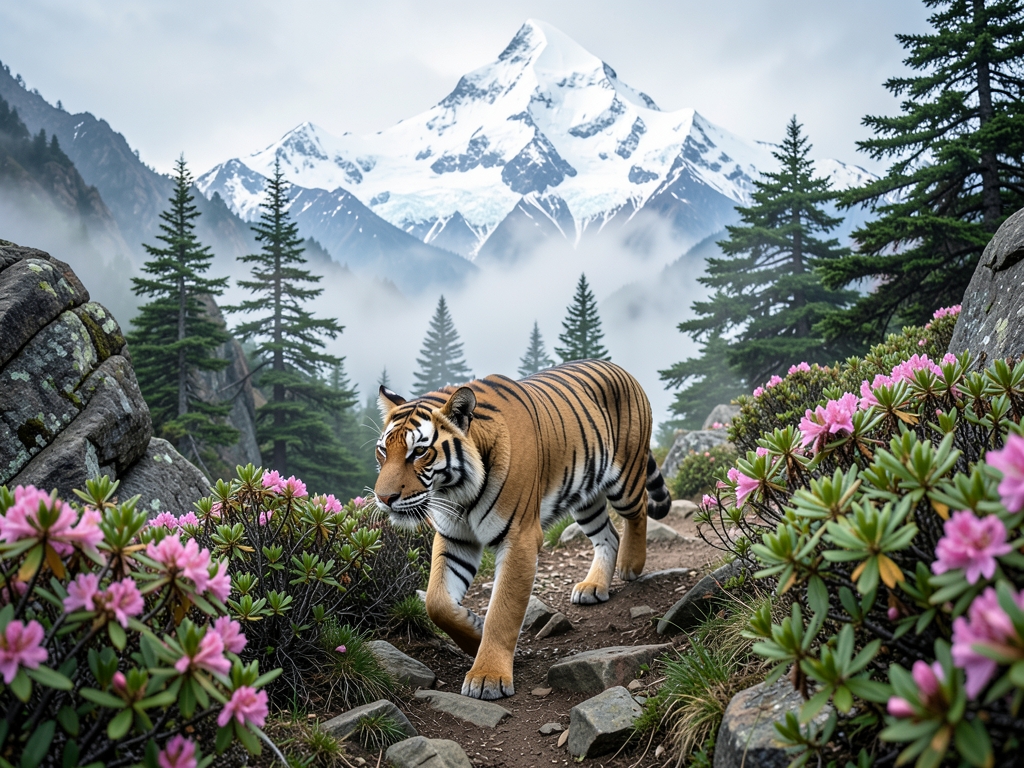
Recent ecological surveys in the Eastern Himalayan state of Sikkim have uncovered historic wildlife observations, establishing new high-altitude elevation records for major Asian mammal species. Motion-sensor camera traps deployed across rugged mountain corridors recorded a gaur (Indian bison) at an elevation of 3,542 meters above sea level and a Bengal tiger at 3,966 meters. These observations challenge longstanding ecological assumptions regarding the spatial limits, thermoregulatory boundaries, and habitat preferences of large terrestrial mammals in high-mountain ecosystems.
The Eastern Himalayas represent one of the world's most biologically complex regions, characterized by extreme elevation gradients, dense forest zones, and rapid climatic shifts over brief geographic distances. Historically regarded as low-elevation and foothill inhabitants, apex predators and megaherbivores are increasingly documented navigating alpine and subalpine environments. The discovery provides critical empirical data on how species alter their geographic ranges in response to shifting microclimates, changing prey distribution, and human-driven landscape modifications in lowland habitats.
Understanding the Sikkim High-Altitude Wildlife Study
The extensive camera-trapping survey was conducted across diverse ecological zones in Sikkim, spanning temperate broadleaf forests, subalpine conifer belts, and high-altitude alpine meadows. By deploying heat and motion-sensitive cameras along remote ridge lines, animal paths, and natural mountain passes, field researchers captured non-invasive photographic proof of species presence in areas previously considered beyond their physiological tolerances.
Info! High-altitude camera traps in Sikkim have recorded species living hundreds of meters above their historically recognized range limits, offering vital insights into Himalayan biodiversity dynamics.
The recording of a gaur at 3,542 meters is particularly notable. The gaur (Bos gaurus) is the world's largest wild bovine species, traditionally associated with lowland tropical moist deciduous forests, semi-evergreen woodlands, and foothill grasslands. Finding this massive herbivore in subalpine habitats demonstrates unexpected ecological flexibility and suggests that high-altitude forest patches supply adequate forage and thermal shelter during specific seasonal windows.
Equally extraordinary is the documentation of a Bengal tiger (Panthera tigris tigris) at 3,966 meters. While tigers have occasionally been documented in high-altitude zones in Bhutan and Nepal, recording an individual near the 4,000-meter mark in Sikkim highlights the vital role of intact high-elevation ecological corridors. At this altitude, environmental conditions are characterized by reduced atmospheric pressure, low ambient temperatures, and sparse cover, requiring significant physiological and behavioral adaptation.
Comparative Elevation Records for Himalayan Fauna
To understand the significance of these findings, it is helpful to compare traditional habitat ranges with the newly documented elevation records in the Eastern Himalayas. The table below details key species, historical baseline ranges, and newly verified elevations based on recent field monitoring.
| Species Name | Scientific Name | Historical Range Baseline | Newly Documented Elevation | Primary Habitat Zone Observed |
|---|---|---|---|---|
| Bengal Tiger | Panthera tigris tigris | Lowland forests to 2,000m | 3,966 meters | Subalpine scrub & ridge corridors |
| Gaur (Indian Bison) | Bos gaurus | Foothill plains to 1,500m | 3,542 meters | High-altitude conifer & bamboo zones |
| Snow Leopard | Panthera uncia | 3,000m to 5,400m | 3,000m to 5,200m (Overlapping) | Alpine scree & bare rock slopes |
| Common Leopard | Panthera pardus | Plains to 2,500m | 3,200 meters | Temperate ridge & subalpine forest |
| Dhole (Asiatic Wild Dog) | Cuon alpinus | Deciduous forests to 2,000m | 3,600 meters | Alpine meadows & forest margins |
Drivers Behind High-Altitude Range Adjustments
The presence of large carnivores and megaherbivores at high elevations is not an isolated anomaly. Instead, it reflects a complex interplay of ecological drivers operating across spatial and temporal scales. Field ecologists and conservation scientists identify several key factors facilitating this upward shift.
1. Climate Change and Thermal Microclimates
Global climate change is altering mountain environments faster than many lowland ecosystems. Rising average temperatures in the Himalayas are causing treelines to shift upward and reducing winter snow retention times. As temperate forest belts migrate to higher elevations, they create suitable thermal microclimates and vegetation structures that permit lowland species to survive at altitudes that were previously too cold.
2. Prey Movement and Herbivore Distribution
Carnivore movement patterns are inextricably linked to prey density. As wild ungulates such as wild boar, barking deer (muntjac), and sambar move upward into subalpine habitats to access fresh vegetation, predators naturally follow. Additionally, high-altitude ranges bring tigers into spatial overlap with alpine ungulates such as blue sheep (bharal) and Himalayan tahr, creating novel predator-prey dynamics.
3. Lowland Habitat Fragmentation and Human Pressure
Human expansion in valley bottoms and foothill regions—including infrastructure development, agricultural conversion, and linear transport corridors—exerts severe pressure on wildlife populations. In response, wide-ranging species utilize high-altitude forest blocks as refuge habitats and movement corridors, allowing them to travel between protected areas without encountering human settlements.
The presence of tigers at nearly 4,000 meters proves that high-altitude Himalayan ecosystems serve as critical movement corridors and climate refuges for wide-ranging mammalian species.
Physiological and Behavioral Adaptations in High Elevations
Operating near 4,000 meters presents substantial environmental stresses for species adapted to lowland forests. The atmospheric pressure at 4,000 meters is roughly 40% lower than at sea level, resulting in reduced oxygen availability. Furthermore, ambient temperatures can drop dramatically overnight, requiring specialized behavioral strategies.
Warning! Rapid warming and habitat fragmentation are pushing species into narrow mountain passes, increasing spatial overlap between lowland carnivores and sensitive alpine species.
Large mammals adapt to these harsh high-altitude conditions through distinct physiological and behavioral adjustments:
- Thermoregulatory Adjustment: Tigers and gaurs modify their active hours during high-altitude residency, utilizing solar radiation during morning periods and seeking dense subalpine forest canopy to shield against freezing winds at night.
- Metabolic Plasticity: Predators lower their energy expenditure by utilizing low-resistance movement routes, such as natural ridge lines and animal trails, rather than navigating dense alpine scrub or steep ravines.
- Dietary Shifts: Large carnivores display opportunistic hunting behaviors, adjusting their prey selection based on the specific species composition of high-elevation ecological zones.
Camera-Trap Methodology in Extreme Terrains
Documenting rare wildlife in steep Himalayan terrain demands specialized field methodologies. Standard wildlife surveying techniques used in flat grassland reserves or tropical forests are inadequate for high-altitude environments characterized by extreme topography, unpredictable weather, and limited access.
- Corridor Identification: Field crews examine satellite imagery and local topographic maps to locate natural funnel features, mountain passes, and ridgelines that wild animals use to navigate high-altitude landscapes.
- Equipment Weatherization: Motion-activated cameras are fitted with reinforced weatherproof housing and high-capacity lithium batteries designed to withstand sub-zero temperatures and high humidity.
- Strategic Field Placement: Units are mounted on stable rock faces or sturdy subalpine tree trunks at precise angles to capture clear side-profile images without trigger delays caused by wind-blown vegetation.
- Periodic Data Retrieval: Field researchers undertake hazardous multi-day treks at regular intervals to collect memory cards, inspect battery levels, and maintain camera calibration.
Conservation Challenges and Ecological Overlap
While the discovery of high-altitude tigers and gaurs in Sikkim demonstrates biological resilience, it also introduces complex conservation challenges. The upward range expansion of lowland species creates ecological overlap with native high-altitude specialists, such as the snow leopard (Panthera uncia) and the red panda (Ailurus fulgens).
As common leopards and tigers enter subalpine and alpine zones, competition for prey and territorial space with snow leopards may increase. Snow leopards are specialized high-altitude predators adapted to steep, barren cliffs. Increased encounter rates with larger, more aggressive tigers could displace snow leopards from lower margins of their range, forcing them into higher, less productive rocky terrain.
Furthermore, human-wildlife conflict dynamics shift as large carnivores move into alpine pastoral landscapes. Local yak herders and high-altitude communities that rarely encountered lowland predators now face potential livestock losses. Designing effective community-based compensation programs and predator-proof livestock shelters in remote Himalayan valleys is essential to prevent retaliatory actions.
Policy Strategies for Himalayan Corridor Protection
Protecting wildlife in high-altitude landscapes requires an integrated regional strategy that extends beyond isolated park boundaries. Because animals traversing high-altitude zones cross administrative and international borders, conservation efforts must emphasize landscape connectivity.
- Establishing Landscape Corridors: Connecting high-altitude sanctuaries with lowland tiger reserves ensures safe movement pathways and prevents genetic isolation among fragmented populations.
- Transboundary Conservation Cooperation: Coordinating monitoring efforts between India, Bhutan, and Nepal facilitates joint tracking of wide-ranging species across shared Himalayan watersheds.
- Community-Led Conservation Initiatives: Engaging indigenous Himalayan communities in camera-trap monitoring, eco-tourism, and anti-poaching patrols enhances local stewardship of fragile mountain ecosystems.
- Climate-Smart Reserve Design: Incorporating elevation gradients into protected area planning ensures that species have room to move upward as global temperatures rise.
What are the newly recorded wildlife elevations in Sikkim?
Recent camera-trap research in Sikkim documented a gaur (Indian bison) at an elevation of 3,542 meters and a Bengal tiger at 3,966 meters above sea level, setting new elevation records for both species in the region.
Why are Bengal tigers moving to high altitudes in the Himalayas?
Tigers move to higher elevations due to a combination of factors, including climate-induced temperature shifts, tracking prey species that move upward, and escaping human disturbance and habitat fragmentation in lowland forests.
Does the presence of tigers at high altitudes impact snow leopards?
Yes, increased overlap between tigers and snow leopards in subalpine zones can lead to competition for prey and territory, potentially displacing snow leopards into higher, less productive rocky environments.
How do researchers capture wildlife data at high Himalayan altitudes?
Ecologists deploy weatherized, motion-sensor camera traps along strategic mountain passes, ridgelines, and forest corridors to non-invasively record animal movements in rugged high-altitude terrain.
Conclusion: Reinterpreting Himalayan Ecosystems
The groundbreaking documentation of gaur at 3,542 meters and Bengal tigers at 3,966 meters in Sikkim marks a pivotal moment in Himalayan ecological science. These findings confirm that high-altitude mountain landscapes are not marginal fringes for lowland wildlife, but vital habitats and essential corridors that support long-term species survival. As environmental pressures reshape global biodiversity patterns, maintaining uninterrupted landscape connectivity from foothill forests to alpine meadows will remain the cornerstone of effective conservation in the Eastern Himalayas.
