

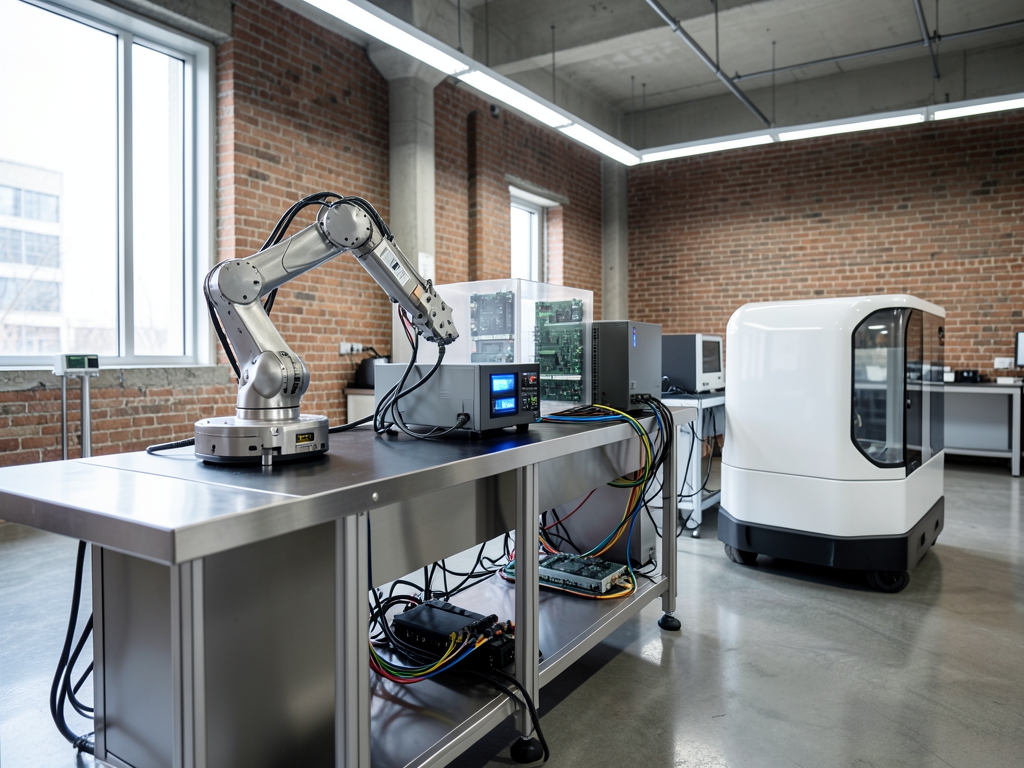
The rapid convergence of artificial intelligence and physical machinery has transformed the landscape of industrial automation, autonomous navigation, and commercial robotics. Engineers and systems architects constantly face the challenge of bridging abstract machine learning models with deterministic, safety-critical hardware. Addressing this industry-wide bottleneck, NXP Semiconductors has officially unveiled its unified robotics platform designed specifically to accelerate the deployment of trusted physical AI applications across diverse operational environments in Europe, the United States, and global markets.
Physical AI represents a significant departure from traditional cloud-based language and vision models. While text and image generators operate within digital sandboxes, physical AI systems command real-world actuators, navigate complex human environments, and make split-second decisions where safety and reliability are non-negotiable. Industrial robots, delivery drones, automated agricultural machinery, and warehouse logistics units require compute architectures capable of processing massive sensory inputs while maintaining strict real-time performance guarantees. The introduction of a unified robotics ecosystem aims to streamline these intricate workflows by integrating hardware processing units, safety certifiable software stacks, and standardized connectivity protocols into a cohesive framework.
The Core Architecture of Unified Robotics Platforms
Modern robotic systems traditionally rely on fragmented hardware and software components assembled from disparate vendors. This mosaic approach frequently introduces integration friction, latency issues, and vulnerabilities in system security. NXP’s newly announced platform addresses these hurdles by providing a standardized foundational architecture that harmonizes microcontroller efficiency with high-performance neural processing capabilities.
At the heart of this unified architecture lies scalable silicon designed to handle heterogeneous workloads. Multi-core application processors work in tandem with dedicated neural processing units (NPUs) and real-time co-processors. This separation of concerns ensures that deterministic control loops governing motor actuation and safety shutdown protocols remain completely undisturbed by intensive AI inference tasks running concurrently on the system. Such architectural isolation is vital for achieving functional safety certifications required by international regulatory bodies, particularly in industrial automation and autonomous transport sectors across North America and Europe.
Accelerating Development Cycles for Enterprise Engineers
Deploying physical AI from laboratory prototypes to commercial production lines is notoriously time-consuming and expensive. Development teams routinely spend months writing custom hardware abstraction layers, debugging communication buses between sensors and compute modules, and validating safety mechanisms against stringent industry standards. A unified development environment dramatically alters this economic equation by offering pre-integrated software packages, standardized middleware support, and verified reference designs.
By utilizing modular software development kits (SDKs) and standardized communication protocols such as ROS (Robot Operating System) integrations, developers can port perception algorithms and motion planning models across different hardware tiers without rewriting foundational codebases. This portability allows engineering firms to scale their product portfolios efficiently, launching entry-level automated devices as well as high-end autonomous machinery using the same underlying software paradigm. Furthermore, integrated simulation tools allow teams to test collision avoidance, spatial mapping, and neural network responses within virtual environments before physical hardware deployment, minimizing costly field failures.
Ensuring Safety, Security, and Trust in Physical AI
As autonomous systems assume greater operational autonomy in shared human spaces—ranging from hospital corridors to busy manufacturing floors—the demand for robust cybersecurity and verifiable functional safety has intensified. Physical AI applications are prime targets for malicious interference, making secure boot processes, hardware-level encryption, and cryptographic isolation mandatory features for modern robotic designs.
Info! The integration of hardware root-of-trust mechanisms ensures that unauthorized firmware modifications or malicious remote intrusions are blocked at the silicon level before operational commands can reach physical actuators.
Beyond digital cybersecurity, trusted physical AI requires predictable behavior under edge-case conditions. Sensor failures, occluded lenses, or unexpected environmental obstructions must be handled gracefully by redundant safety systems. The new platform incorporates hardware-enforced monitoring channels that continuously verify sensor data integrity and immediately trigger fail-safe states if anomalous behavior is detected within the neural inference pipeline. This multi-layered defense strategy satisfies the rigorous compliance frameworks mandated by safety regulators in both the European Union and the United States.
Industry Impact and Future Outlook
The rollout of NXP’s unified robotics platform arrives at a critical juncture for the global technology and manufacturing sectors. Enterprises across automotive, logistics, medical technology, and smart infrastructure are aggressively seeking ways to deploy AI-driven automation without incurring prohibitive custom engineering costs. By lowering the barrier to entry for secure, high-performance physical AI, standardized platforms catalyze innovation across smaller engineering firms as well as established industrial giants.
As these technologies mature, the distinction between digital computing and physical machinery will continue to blur. Edge-computed neural networks will empower machines to adapt dynamically to unstructured environments, learning from operational experience while adhering to strict deterministic safety bounds. The establishment of robust, unified foundational platforms ensures that this next wave of autonomous innovation rests upon a secure, scalable, and trusted engineering foundation.
What is a unified robotics platform in physical AI?
A unified robotics platform integrates scalable multi-core processing hardware, dedicated neural processing units, functional safety software, and standardized communication protocols into a single cohesive framework to streamline the development and deployment of autonomous machinery.
Why is hardware isolation important for robotic safety?
Hardware isolation separates intensive AI inference tasks from deterministic real-time control loops, ensuring that critical motor actuation and emergency safety shutdown protocols remain uninterrupted and fully reliable under all operating conditions.
How do pre-integrated software tools accelerate development cycles?
Pre-integrated SDKs, standardized middleware, and verified reference designs eliminate the need for engineers to write custom hardware abstraction layers from scratch, allowing teams to port perception models seamlessly and test workflows in virtual simulation environments.
What role does cybersecurity play in modern physical AI deployments?
Cybersecurity features like hardware roots-of-trust, cryptographic isolation, and secure boot processes protect autonomous machinery against unauthorized firmware tampering and malicious remote intrusions at the silicon level.
The ongoing evolution of physical AI underscores the necessity of robust engineering standards. By addressing hardware fragmentation and security vulnerabilities through unified architectural design, the technology sector paves the way for safer, more intelligent, and widely accessible autonomous systems worldwide.
