

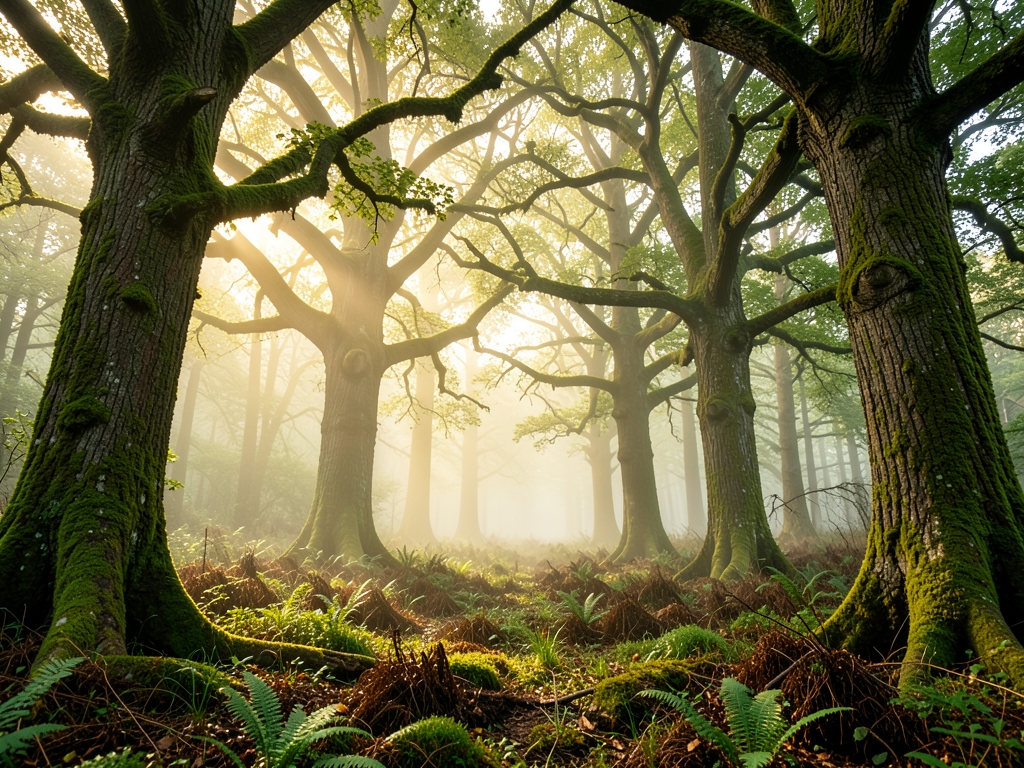
When modern conservationists and ecologists picture the primordial landscapes of Europe before human intervention, they frequently imagine dense, unbroken canopies of dark, shadowy timber stretching endlessly across the continent. For generations, standard ecological theory suggested that prehistoric European ecosystems were so thickly wooded that sunlight barely penetrated the forest floor, creating a uniform, closed-canopy wilderness where large herbivores navigated shadowy understories. However, groundbreaking recent research published in scientific literature has completely overturned these long-held assumptions. By analyzing preserved pollen records, subfossil remains, and sedimentary DNA archives from multiple sites across the continent, researchers have revealed that Europe's ancient forests were nothing like we imagined, featuring dynamic, open, and mosaic-like structures that challenged every textbook definition of pristine wilderness.
The Myth of the Continuous Closed Canopy
The traditional view of European prehistoric vegetation was largely shaped by the mid-20th-century 'high-forest hypothesis.' This model proposed that before Neolithic farmers introduced livestock and cleared land for agriculture, uninterrupted tree cover dominated nearly every lowland and upland region from the Atlantic coast to the Ural Mountains. According to this framework, open areas were restricted exclusively to extreme environments such as high alpine zones, rocky outcroppings, active floodplains, and waterlogged peat bogs. Ecologists used this baseline to guide modern rewilding projects, attempting to recreate dense, shady woodlands as the ultimate gold standard of ecological restoration.
However, recent multidisciplinary investigations have re-examined the botanical and geological proxy data with unprecedented precision. Scientists discovered that pollen accumulation rates and macro-fossil distributions in undisturbed sediment cores tell a radically different story. Instead of a monotonous, light-starved green blanket, ancient European landscapes were characterized by a high degree of structural heterogeneity. Tree cover fluctuated dramatically over centuries, shaped not merely by climate shifts, but by the continuous, active influence of large native herbivores such as aurochs, European bison, wild horses, and red deer.
These megafauna acted as biological engineers, preventing saplings from establishing in certain zones and maintaining open parklands, shrubby thickets, and sunlit glades within the broader woodland matrix. This dynamic interplay between tree growth and animal grazing created a shifting mosaic of habitats that supported a far greater diversity of light-loving plant and insect species than a static, closed-canopy forest ever could.
Decoding the Botanical Archives: Sedimentary DNA and Pollen
Unlocking the true nature of prehistoric ecosystems required moving beyond visual assumptions and tapping into microscopic archives. Researchers extracted ancient environmental DNA (sedimentary aDNA) from ancient lake beds and peat deposits alongside high-resolution pollen counts. This genetic approach allows scientists to identify plant species that produce very little pollen or whose pollen is easily degraded, providing a vastly more accurate inventory of ancient biodiversity.
The results were astonishing. Data showed that sun-loving tree species such as oak and hazel, along with numerous herbaceous flowering plants, thrived in abundances that are incompatible with a continuous closed-canopy model. Furthermore, the presence of light-dependent insect communities and avian indicators preserved in the fossil record confirmed that open habitats were a permanent, stable feature of the prehistoric European biome rather than temporary anomalies.
The prehistoric European landscape was not a uniform wilderness of shadows, but a vibrant, shifting patchwork of dense groves, open meadows, and scrublands maintained by large native herbivores.
These revelations force a major rethinking of how historical baselines are established for nature conservation. For decades, land managers sought to restore forests by maximizing tree density. The new scientific consensus suggests that true ecological restoration should prioritize structural diversity, open glades, and the reintroduction of natural grazing processes that mimic the ancient disturbance regimes.
Implications for Modern Rewilding and Conservation Strategy
Understanding that Europe's ancient forests were remarkably open and diverse carries profound implications for contemporary conservation biology. Across Europe and North America, conservation groups are increasingly adopting evidence-based frameworks that move away from rigid, tree-planting-centric reforestation models. Planting millions of closely spaced saplings of a single species may increase raw carbon metrics on paper, but it often fails to recreate resilient, biodiverse ecosystems capable of withstanding climate change.
Info! Modern ecological studies emphasize that structural complexity and natural disturbance cycles are far more critical for long-term biodiversity than sheer tree density.
Conservationists are now integrating these insights into large-scale rewilding initiatives. By allowing natural processes to shape habitats—such as introducing free-roaming herbivores and protecting natural river dynamics—managers can encourage the development of mosaic landscapes. These dynamic environments prove far more resilient against extreme weather events, pest outbreaks, and prolonged droughts.
To visualize how modern conservation priorities are shifting in light of these historical revelations, consider the following comparative framework:
| Conservation Paradigm | Traditional Closed-Canopy View | Updated Ancient Forest Model |
|---|---|---|
| Tree Density | Maximum possible density across all land | Dynamic mosaic of groves, glades, and scrub |
| Driver of Structure | Climate and natural succession only | Megafauna grazing and natural disturbance |
| Biodiversity Focus | Shade-tolerant woodland specialists | Edge species, pollinators, and light-lovers |
| Restoration Goal | Unbroken forest cover | Process-led, structural heterogeneity |
Biodiversity Lessons from the Past
The realization that ancient European forests were rich in transitional zones and sunlit spaces highlights the ecological importance of habitat edges. In modern fragmented landscapes, edges often represent dangerous boundaries where wildlife meets roads and agricultural fields. However, in a wild, unfragmented ecosystem, internal edges—where dense forest meets open meadow—are hotspots of biological productivity.
Insects, pollinators, reptiles, and ground-nesting birds all find essential resources in these transitional ecotones. The new scientific data proves that European wildlife evolved alongside these open spaces. Consequently, conservation strategies that artificially suppress natural disturbances or eliminate grazing animals inadvertently starve the ecosystem of the very habitats that supported its most diverse communities for millennia.
Frequently Asked Questions
What did scientists discover about Europe's ancient forests?
Recent research shows that prehistoric European forests were not continuous, dark, closed-canopy woodlands as previously believed. Instead, they formed a dynamic, open mosaic of dense groves, sunlit glades, and shrubby areas maintained by large grazing animals.
How did researchers uncover this new understanding of ancient ecosystems?
Scientists analyzed high-resolution pollen records, macro-fossils, and sedimentary ancient DNA (aDNA) extracted from undisturbed lake beds and peat bogs across Europe to reconstruct past plant communities accurately.
What role did large animals play in shaping prehistoric European landscapes?
Large herbivores like aurochs, wild horses, and European bison acted as natural landscape architects. Their grazing, browsing, and trampling prevented saplings from taking over everywhere, maintaining open meadows and diverse edge habitats.
How does this research impact modern conservation and rewilding efforts?
It shifts modern restoration goals away from simply maximizing tree density. Conservationists are now focusing on creating structural diversity, encouraging natural disturbance cycles, and supporting mosaic habitats that benefit a wider range of species.
Conclusion
The revelation that Europe's ancient forests were diverse, open, and dynamic landscapes fundamentally reshapes our understanding of ecological history. By moving past the outdated myth of the unbroken dark wilderness, modern science provides a clearer, more accurate blueprint for nature conservation. Embracing structural heterogeneity, natural grazing processes, and habitat mosaics will be essential for building resilient ecosystems capable of thriving in a rapidly changing world. Protecting and restoring nature requires us not just to plant trees, but to recreate the complex, living relationships that allowed ancient ecosystems to flourish.
